Simone de Beauvoir is twenty‑two. On a whim and a letter of introduction, she has crossed Germany to visit the much older Lou Andreas‑Salomé.
At sixty‑nine, Salomé is a well-known author and psychoanalyst in her own right. She is no mere footnote.
She has spent decades escaping being one and outlived most of the men who tried to own her in some form.
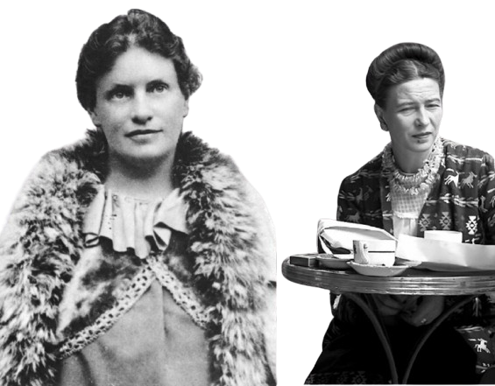
Lou von Salomé & de Beauvoir
Simone has come a long way to see her because she feels, rightly, that, in spite of their age difference, they have much in common.
The older woman does not rise from her chair. Lou simply looks. “So, another young woman who has decided being married is a cage, ” she says.
Simone does not flinch. “I have decided nothing yet. I am only refusing to decide too soon.”
A silence. Then Lou laughs, once, low in her throat. “That is the correct answer. Sit down.”
They talk for three hours. The maid brings tea twice and is waved away both times. Simone asks the question she came to ask.
“Salomé, you lived once with two men, under one roof, and called it philosophy.
You had other triangles in which you compared the relationships to mobiles moving separately but from the same source.
Lou’s face does not soften. “Nietzsche wanted a disciple. Rée wanted a wife who was not a wife.
I wanted a mind of my own with witnesses to it. So I built a household with no bed in the arrangement at all.
People assumed the worst because they could not imagine a woman refusing both offers at once.”
Simone leans forward. “I have done something similar. Not chastely.”
“I know what you have done. Word travels, even to here in Göttingen. You share a man with other women, by agreement, and you call it freedom, or Contingency.”
Simone de Beauvoir smiles: “Yes, it is freedom. We chose it. No one has been deceived.”
Lou’s eyes narrow, not unkindly. “Were the young women your students, before they were your equals in bed?”
The question lands hard. A pause opens between them, long enough to feel it. “Yes. That is the part I have not resolved.”
“Then do not dress it in my language,” Lou says. “My arrangement had no professor and no pupil in it. Yours does.
Call it what it is, and decide afterwards if you can still defend it.”
Simone sits with that. The tea goes cold in both cups. “You are hard on me,” she says at last.
“I am hard on everyone who claims my life as a precedent. I did not invent the triangle to be admired.
I invented it because the ordinary shape of a woman’s life had no room at the time, for me in it.”
“And philosophy, Lou? Did that give you room?” Lou’s whole posture changes and something almost young moves through it.
“Philosophy was the one house from which no man could evict me. My father wanted a bride. The Church wanted a convert.
I gave them neither. I gave them Kant and Nietzsche instead, and they had no answer for that.”
Simone smiles fully, for the first time. “My father wanted there to be a wife too. I gave him the agrégation, the most competitive and prestigious examination for civil service in our public education system.
“Then we are the same animal,” Lou says. “Women who discovered that a mind, properly armed, is harder to marry off than a body.”
Outside, the light is failing. Simone knows she should leave for her train.
She asks one more question, the one underneath all the others. “Did it cost you? What was the bill? The freedom?”
Lou considers this longer than anything else that afternoon.
“Everything costs. Rée died believing I had ruined him. Nietzsche wrote sentences about me for the rest of his life, none of them kind.
I do not regret the choosing. I regret that no one warned me how long the bill remains unpaid.”
Simone will write this down later on the train in the small hand she uses for things she does not want to lose.
She, in turn, will build her own bill. Algren, Sartre, the students, the decades of half‑told truths. She does not know this yet, standing at Lou’s gate in the dark.
She only knows she has met the one woman old enough to tell her the door was never really open.
As she walks back to the station, Simone reflects that the door to freedom for women is only ever unlocked, and unlocking a door is not the same as walking through it unhurt.

I write imagined conversations with history’s most remarkable figures: women, Visionaries, and creative minds. Not summaries, but actual encounters. Real lives, reimagined in dialogue.
If you’ve ever wanted to hear the past answer back, you’re in the right place. I call it History Speaks.
Thanks for reading! Subscribe for free to receive new posts and support my work.