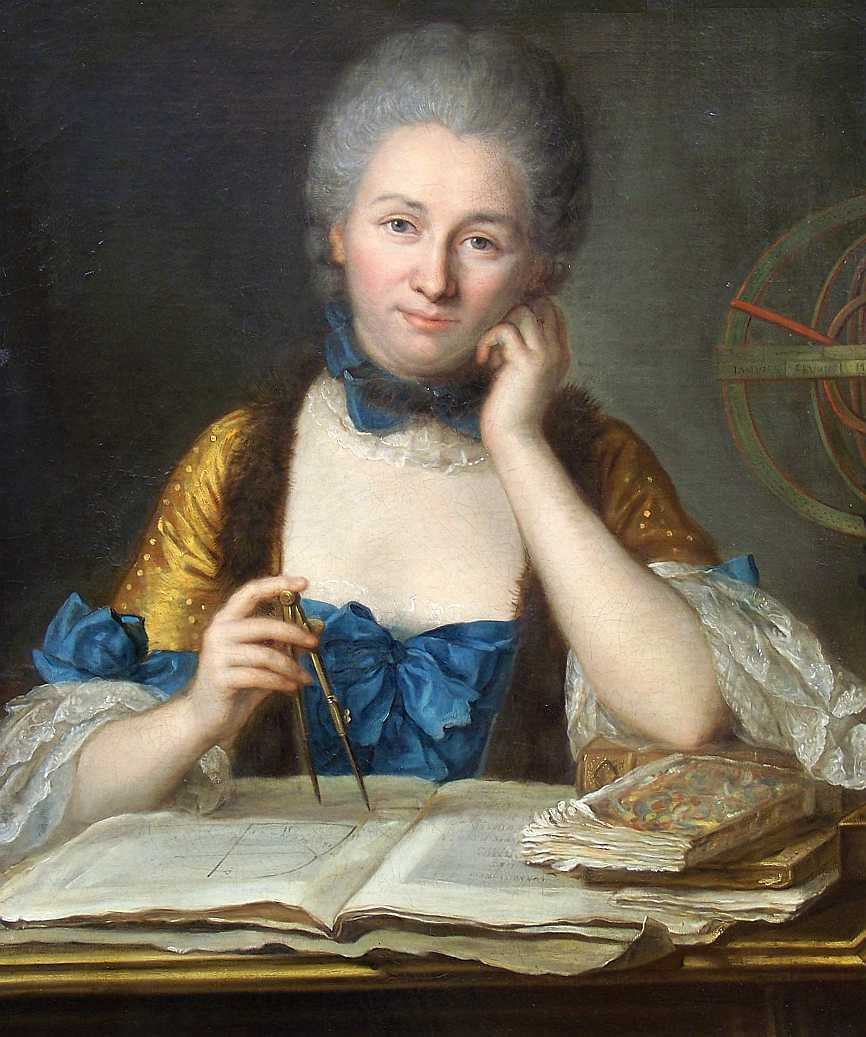
Émilie du Châtelet by Marianne Loir, c.1745, armillary sphere behind her, dividers in her hand. The femme savante refuses to apologise.
Émilie du Châtelet wasn’t just smart “for a woman.” She was quite simply brilliant. A straight-up science queen in a world where women weren’t even supposed to read science books, let alone understand them.
We’re talking 1700s France, otherwise known as the so-called Enlightenment. This was when a bunch of bold thinkers were strutting around saying the equivalent of:
“Hey, maybe we should question authority, use reason, and try actual science instead of just doing whatever the church says.”
Revolutionary stuff. Some even said condescending things like, “Maybe some of the women are quite bright. How can we help them shine?”
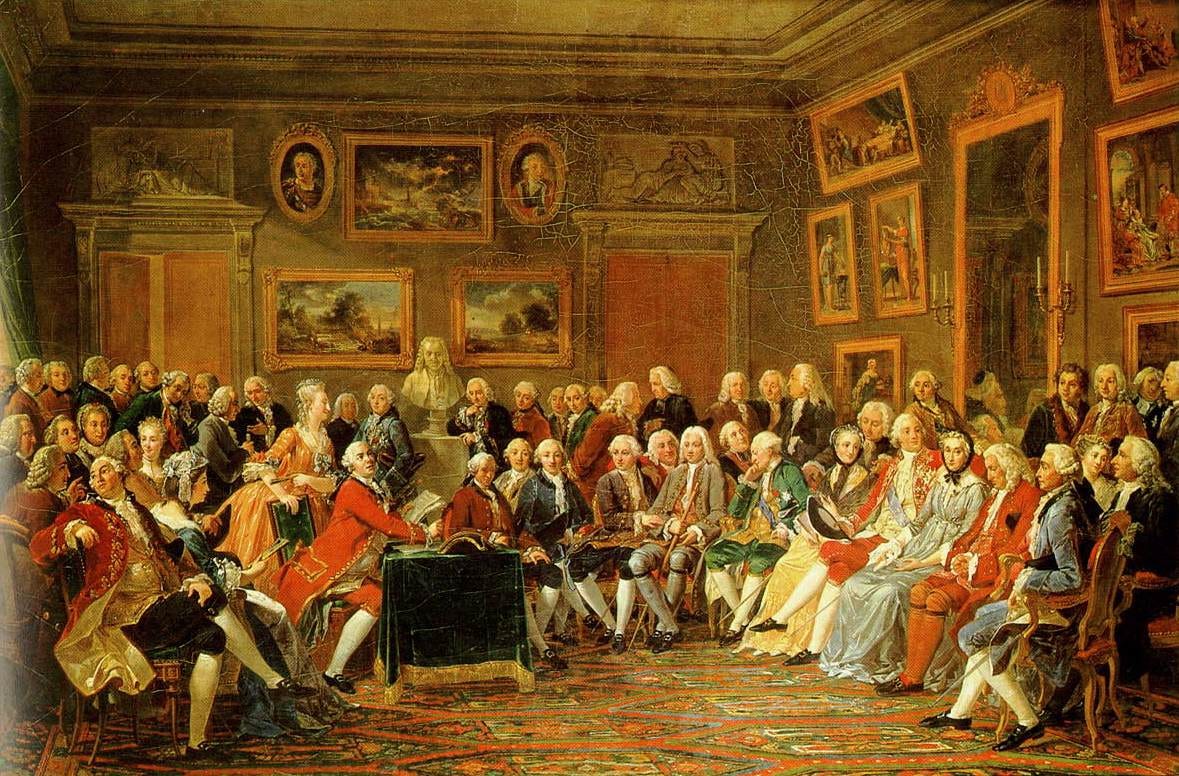
An Enlightenment salon (Lemonnier, 1812)
Reading of Voltaire’s L’Orphelin de la Chine in Madame Geoffrin’s salon, an imagined gathering of fifty-five Enlightenment figures, with Voltaire’s bust presiding.
Enter Émilie: aristocrat, genius and rebel. While society told her to play piano and get married, what was Émilie doing? Obviously, reading philosophy, building her own lab, and translating Isaac Newton’s Principia Mathematica.
Newton’s monster book was hardly a thrilling read, at least to the rest of us. But Émilie couldn’t get enough of explanations of gravity, motion, and why apples fall.
Smart Newton discovered the laws of motion. Superbright Émilie focused mainly on kinetic energy, and in doing so figured out how to explain it to the rest of us. Well, not quite everyone, but anyone willing to read her explanations.
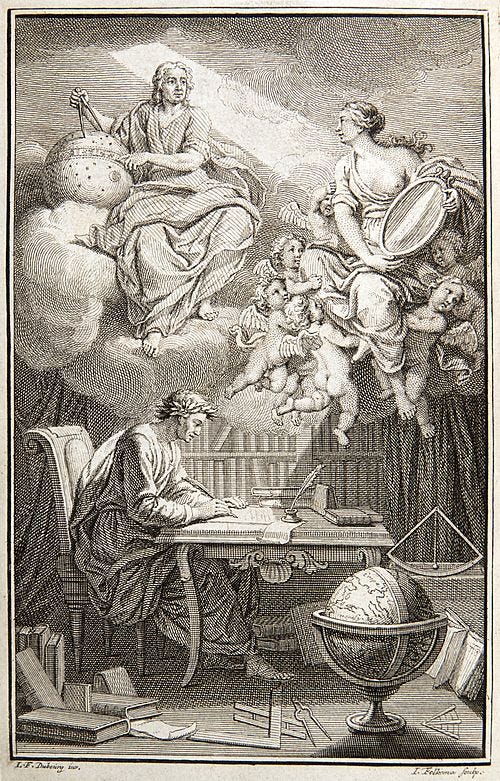
Émilie as Voltaire’s muse (Newton frontispiece, 1738)
The frontispiece of Voltaire’s Élémens de la philosophie de Newton (1738): Newton beams divine light from above, Émilie holds the mirror that reflects it down to Voltaire’s hand. Voltaire’s quiet acknowledgement of who was really doing the thinking.
But science wasn’t Émilie’s only drama. She had four kids, three by her husband and the fourth out of wedlock by a French poet and army officer.
Next, she had a long-term open arrangement with both her husband and Voltaire as a live-in lover at her house, Cirey.
Naturally, some people called Émilie a courtesan, which is the 1700s word for “expensive mistress, or worse.” But Émilie was like, shrug, “Don’t bother me with trivia, I’ve got equations to solve.”
Émilie du Châtelet, pastel by Maurice Quentin de La Tour
Now let’s talk about her very extra situationship with Voltaire. He was the straight-up enlightenment’s gossip king. Think: philosopher meets political blogger meets chaos gremlin.
The big V wrote savage critiques of society, kept massive diaries, and popped up everywhere, chatting with royals, writers, and rebels.
It wasn’t just Émilie; later, after Émilie’s death, he even corresponded with Catherine the Great, Empress of Russia, who couldn’t get enough of him. This communicator turned messaging into an art form.
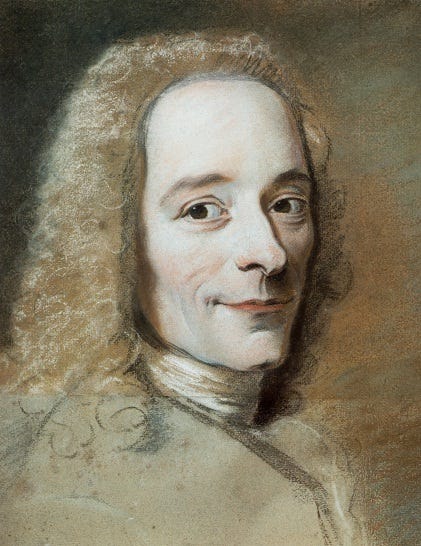
Voltaire, the chaos gremlin Voltaire, by Maurice Quentin de La Tour, 1735, the year he and Émilie set up house at Cirey.
Voltaire and Émilie weren’t just lovers; they were intellectual powerhouses. He called her his muse, but she was way more than that. She taught him things.
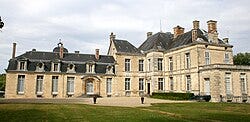
Together, they turned her château into a science-and-philosophy clubhouse. It had a lab, a library with OVER 20,000 books and definite vibes.
The Château de Cirey, their science-and-philosophy clubhouse where Émilie and Voltaire lived, worked, argued, and ran a 21,000-volume library from 1734 until her death in 1749.
Émilie didn’t care what people said. She wasn’t trying to impress men; she was too busy trying to understand the universe.
She worked on theories of energy, helped shape early thermodynamics (hello, science class), and proved that women’s brains are just as wired for genius as men’s.
Her château became a full-on Enlightenment think tank, complete with labs, libraries, and big-brain debates. And Émilie? She wasn’t just hosting. She was running the show.
She said it best: “Judge me for my own merits… do not look upon me as a mere appendage to this great general or that great scholar.”
So, you may not have heard of her, but this mother, scientist, rule-breaker, and Enlightenment queen put herself on the map.
If she were around today, she’d be part Einstein, part Beyoncé, and 100% going viral. She’d break the internet without asking permission.
I write imagined conversations with history’s most remarkable figures: women, Visionaries, and creative minds. Not summaries, but actual encounters. Real lives, reimagined in dialogue.
If you’ve ever wanted to hear the past answer back, you’re in the right place. I call it History Speaks.
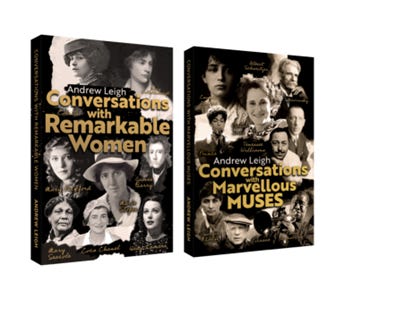
You can read my full-length imaginary interview with Émilie du Châtelet in my book, Conversations With Marvellous Muses: https://tinyurl.com/mrxrh568