An Otrovert is someone who feels most natural on the outside looking in,
preferring one-to-one connections over groups, but always keeping
a slight emotional distance even then.
reference
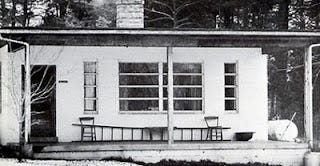
Merton’s famous hermitage is a plain cinder-block, low and unattractive. It sits in a clearing north of the Abbey, St. Mary of Carmel. The name is rather grander than the structure deserves.
To reach it, you walk along a dirt track through the Kentucky woods. It ends well short of the door.
For years, Merton fought for this place. The abbot finally agreed, and Merton became the first American Trappist allowed to live as a hermit.
He moved in on a warm August day in 1965. He wrote in his journal that he had not been so happy in his life.
The place was a living paradox, inhabited by a hermit who wrote bestselling books. A man of silence who could not stop corresponding with the world. A solitary Otrovert who nevertheless welcomed a constant stream of visitors.
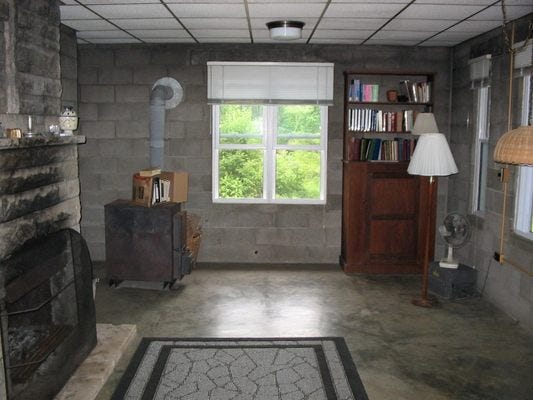
Celebrities, poets, activists and seekers of every kind found their way here. Merton gave each his undivided attention, sometimes for an entire day.
This simple structure was Merton’s withdrawal from the world. With equal stubbornness, this place was his theatre for meeting one person at a time.
For all who crossed the modest threshold, the intense experience was all-consuming and impossible in a group.
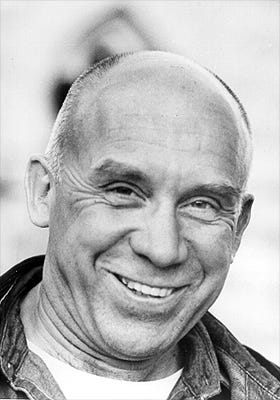
Thomas Merton in 1948
Noise drove Merton to this retreat. Not just acoustic sounds, but also the jangle from many relationships and their multiple obligations. Thomas Merton could not face the competing claims on his attention.
For this American Trappist monk, theologian, mystic, poet, and social activist, noise really mattered.
He was the ultimate Otrovert, someone who loves people, but strictly on his terms. Nor was he an introvert, which he felt others would see as a perversion or even an extrovert with its many demands.
AND NOW?
Yet why should we care about this curious and long-gone monkish Otrovert? He may have written books read by millions, but now? Is he not just a footnote in the endless pages of history? Do you even know his name?
In 1941, aged twenty-six, Merton entered the Abbey of Gethsemani in Kentucky and became a Trappist monk. The world looked at this and saw withdrawal. Merton knew it was the opposite.
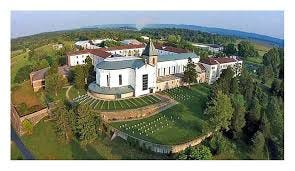
Abbey of Our Lady of Gethsemani, Kentucky
Merton’s home from 1941 until his death in 1968.
The monastery gave Merton something he had never previously possessed: a structure that regulated human contact on his behalf. The hours of the day were fixed. Silence was the default. Conversation was rationed.
For the first time in his life, Merton was not responsible for managing the distance between himself and other people. The institution did it for him.
Yet, paradoxically, what followed was an explosion of engagement with the world. He wrote more than sixty books. He corresponded with hundreds of people, activists, poets, theologians, and strangers. He became one of the most widely read Catholic writers of the twentieth century.
Far from disappearing from human life as Merton originally intended, and as his monastery expected, he plunged into it. But on his own terms, at his own pace, through the medium of the written word.
He was an Otrovert in action. Not someone who fled the world into solitude and introspection, but someone who engineered a sustainable relationship with it. Nor was he even consistent. No true Otrovert is.
In the 1960s, Merton emerged as a fierce voice against the Vietnam War and racial injustice. His many letters and essays reached celebrities such as Dorothy Day, Joan Baez, and the Dalai Lama.
Merton became increasingly dedicated to his Otrovert role, though he did not call it that. It was his commitment to one-to-one relationships that mattered. He fell in love with a student nurse who came to care for him after surgery.
He then conducted an intense relationship by letter and stolen phone calls, intimate, urgent, and safely bounded by geography and his own vows.
Partially due to an electric shock at his hotel near a conference he was attending, Merton died in 1968. He left behind a body of writing that still speaks to any Otrovert who has ever loved people and found them, at the same time, too much.
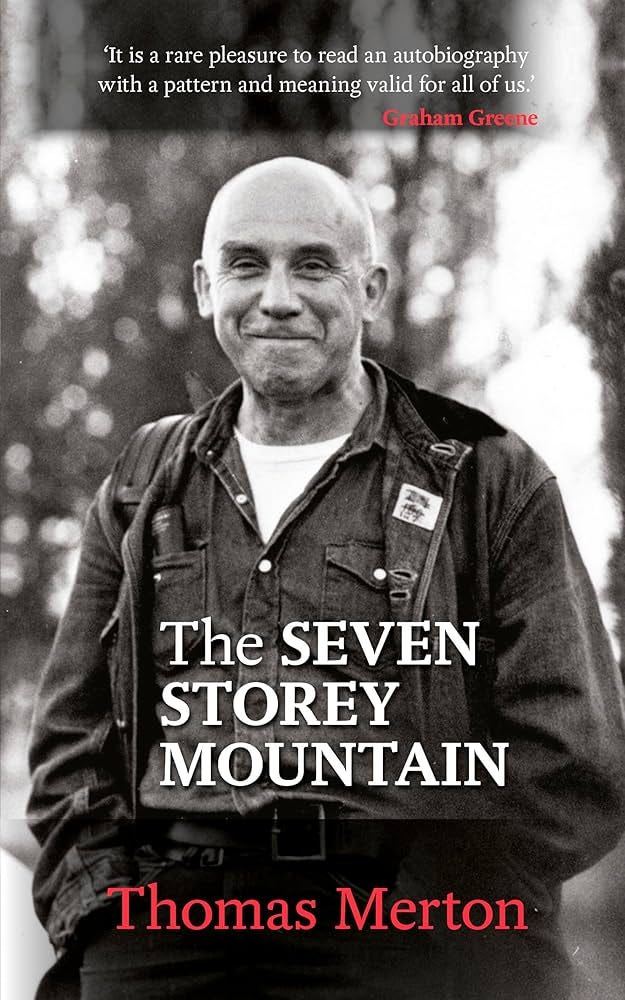
Merton’s autobiography (1948), one of the most
widely read Catholic books of the twentieth century.
His seven volumes of journals land like a live transmission from inside an Otrovert’s mind. There is the hunger for conversation, the relief of solitude, the guilt about the relief, the hunger again.
Merton never resolved that tension. Nor was he supposed to. The tension itself was his work. He understood, and what every Otrovert grasps instinctively: You do not have to choose between connection and solitude.
The real question is not whether to engage with the world. It is about creating the conditions for honest engagement. The sort of engagement that can be sustained, instead of trying to generate some performance, which can be exhausting.
Most of us find solutions other than fleeing to a retreat. Yet Merton’s question remains as relevant now as it ever was. That’s why Thomas Merton still matters.
Our present age has abolished the monastery and replaced it with notifications, by email, buzzy sounds, flashing images, all asking to be seen. Every claim for our attention arrives instantly, and none of it waits its turn.
The noise Merton could not face is now the default condition of our modern life. Merton just got there first.
His question, “how do I stay open to the world without being consumed by it”, is one that anyone who has ever silenced their phone, closed their door, or refused to go online for a meeting will recognise immediately.
Merton’s solution of a monastery was indeed extreme. Yours doesn’t have to be.