A man stands alone in a Mercian field at twilight, around the late seventh century. At his feet, an open pit. Inside it is gold.
It is more gold than most men will see in a lifetime. He has sent everyone else away. He has a shovel. He has been waiting. But for what? It is unclear, and it could be for me? I have come to meet him.
The sky has turned the colour of old iron, and the last light rests in the furrows. The place is near a track, though not on it. A man does not bury such things where wheels and feet will stumble across them.
The man at the pit hears me before he sees me. He turns, one hand on his sword hilt. Tall, but with the tired shoulders of someone who has worn armour long enough for it to change how he stands. Not a peasant. Not quite a king. A fighting man of rank. Someone trusted with power.
We look at each other. “You’re late,” he says.
A: “Late for what?”
“For stopping me.”
He studies me as if deciding not who I am, but what sort of death would fit me. “If you were one of them,” he says, “you would not come alone.” His hand stays on the sword. “If you shout, I will kill you. If you run, I let the spear decide. If you lie, I will know it.”
A: “I’ve not shouted, run, or lied.”
“No,” he says. “That is the difficulty.”
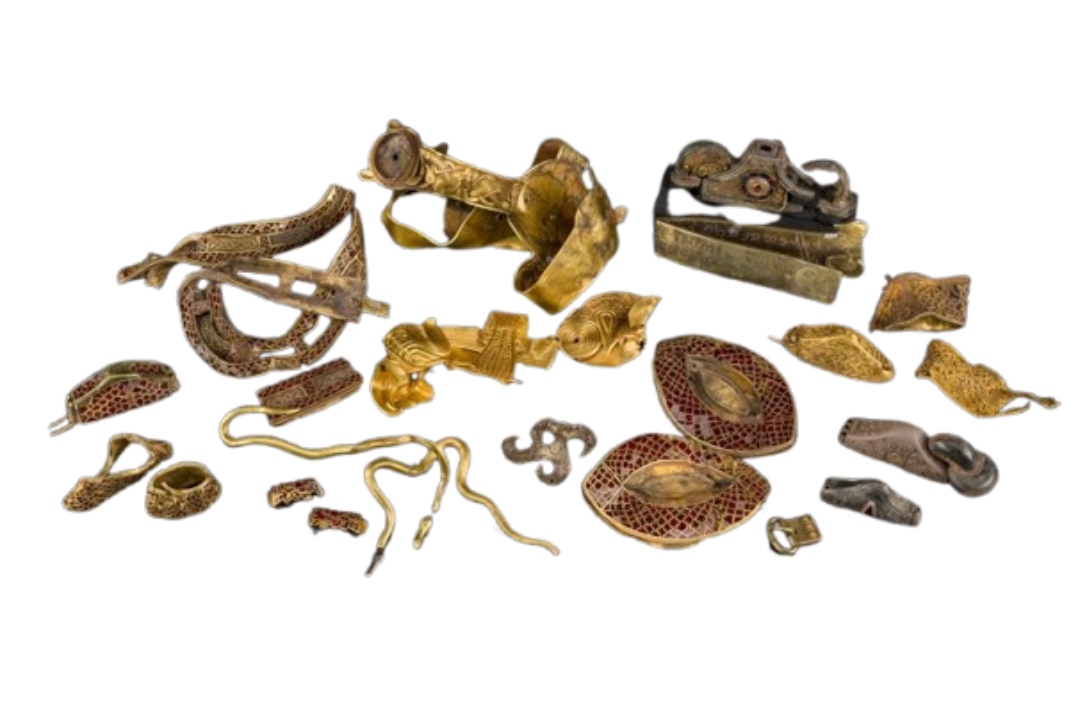
I look past him into the pit. Even in failing light, I can make out worked gold, the red cells of garnet, the curved fitting from some great weapon, all of it dumped yet chosen, damaged yet deliberate.
A: “You are burying treasure.”
“Treasure? A child’s word.”
A: “What would you call it?”
He glances down into the pit as if consulting it. “The shining skin of slaughter.”
That is the moment I know he will speak. Not because he trusts me. Because he needs language for what he is doing and has been alone with it too long.
A: “Why not melt it? Rework it?”
“You think I haven’t asked that? Every man who has seen this has asked it with his eyes. Melt it. Share it. Buy men’s loyalty. Buy priests. Buy silence.”
He drives the shovel into the loose soil and pauses, breathing through some old wound in his side. “Because once melted, it becomes innocent. A chalice can be fashioned from stolen gold. A cross crafted from ripped fittings. Melt it, and all witnesses disappear.”
He looks at me steadily. “I wanted these pieces to stay guilty.”
Near the pit’s edge, he crouches and opens a last bundle of cloth. A curved, damaged piece, part of a face once rendered terrible in battle. Helmet fittings, perhaps. He holds it not like loot but like evidence.
“This sat above a man’s brow while he rode against us. He came bright as a new day.” He turns the piece slowly. “When I first saw it, I thought: take it, keep it, let his glory fasten to mine. That is how such things work. One dead man’s renown becomes another living man’s ornament.”
A: “And now?”
“Now I think glory is a fever passed from hand to hand.”
He lowers the piece into the pit. We both watch it disappear among the rest, as if having an afterthought, he adds:
“There are no coins because this is not silver for counting. There are no women’s brooches because this is not household plunder. This is the cut-off brightness of men who wanted to be remembered in battle.”
A: “So this burial is not hiding wealth. It is hiding names.”
His eyes lift to mine. For the first time, there is something like respect in them.
“Who are you?”
A: “A witness.”
He goes still. The sword stays sheathed. In another world, another instant, this is where he kills me. He knows it. I know it. The knowledge stands between us.
Instead, he says, “Today, as I collected the gold, I touched a dead man’s hilt and felt not triumph but inheritance. Not his gold. His hunger.
I felt how easily I could claim all this, and people would speak my name after I am dust. But I know that if I bore these gold objects into a hall, I would not master them. I would be mastered by what they would make me become.”
A: “And what is that?”
“A brighter kind of beast.” He takes up the shovel. Soil falls across gold. The sound is soft, almost tender. Maybe one day I will return for it, or not. For now, it stays in the ground.
“So I will not claim the gold. Instead, they will find this one day,” he says. “Long after kings’ names have cracked and rotted. They will pull these from the earth and wonder. They will count and measure and argue whose men wore them, which battle bled them?
They will ask why it was buried, why it was broken, and why there were no coins. And they will be right to ask.” He pauses. “But they will not see this night.”
A: “No.”
“Nor will they smell the wet soil. They will not know that one man stood here trying, too late perhaps, to refuse the chain that binds splendour to slaughter.”
When the hole is filled, he straightens, breathing hard.
A: “It looks like nothing.”
“That is the hope.”
A: “And your name?”
He smiles. It is not warmth. “My name is the least true thing about me here.”
A: “You trust me, then?”
“No,” he says. “I entrust you.”
Then he walks into the Mercian dark, and I never see him again, and no one sees his work in the Mercian field for hundreds of years.
I write imagined conversations with history’s most remarkable figures: women, Visionaries, and creative minds. Not summaries, but actual encounters. Real lives, reimagined in dialogue.
If you’ve ever wanted to hear the past answer back, you’re in the right place. I call it History Speaks.
Read the rest of the Glass Jar Stories coming shortly!