23 May 1707 – 10 January 1778
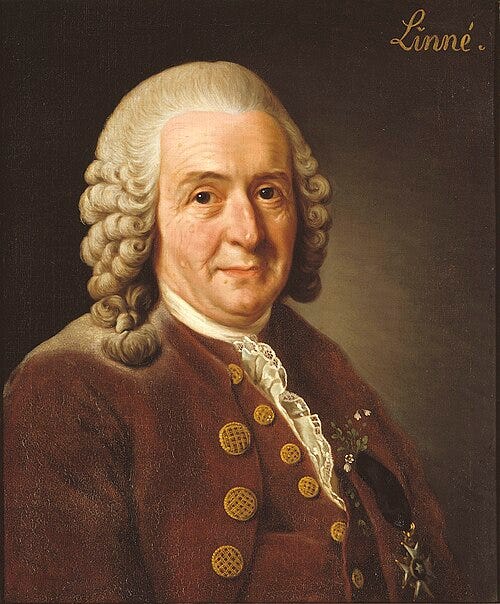
Carl Linnaeus, painted by Alexander Roslin, 1775
Oil on canvas, Nationalmuseum, Stockholm.
23 May 1707 – 10 January 1778
Carl Linnaeus, painted by Alexander Roslin, 1775
Oil on canvas, Nationalmuseum, Stockholm.
Brave or stupid? Linnaeus set out to track down every plant, animal and mineral on earth, with a name and a place.
I am meeting him in the summer of 1773 at Hammarby, his country estate about an hour’s ride from the city.
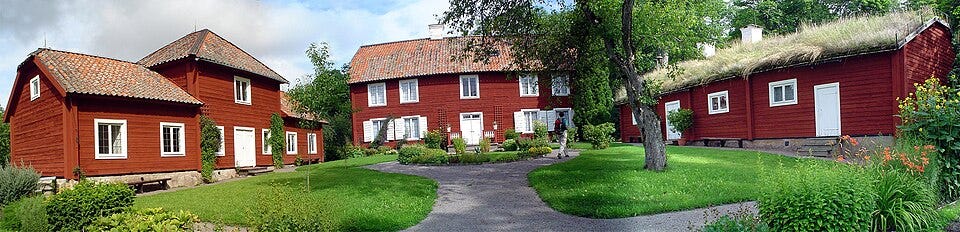
The wooden manor house Linnaeus bought in 1758, about 15 km south-east of Uppsala.
I arrive with a small booklet in my hand. The afternoon sun slants low across the fields of Hammarby. The man I have come to meet is sixty-six.
A servant shows me to his study, a low-beamed room lined with cabinets. Each drawer is labelled in his own neat hand. Bunches of dried herbs hang from a beam above the window.
Beyond it, his garden runs down towards a stream, each bed planted in the careful order of his own system. Linnaeus is smaller than I expected, dressed in plain dark clothes, his greying hair tied back rather than worn under a wig.
His eyes are a pale, surprisingly bright blue: the quick, appraising gaze of a man who has spent his life looking closely at things. He picks up the booklet, turns it over, and smiles faintly, as if meeting an old friend:
“Ah! You have a copy when the ink was hardly dry.”
A: Eleven pages, Professor, that’s all. It is extraordinary to think this is where it all began.
“Eleven pages only. But the intention was never small. I wanted to arrange the whole of nature, to bring animals, plants, and minerals into a clear order so that anyone could understand how the living world fits together.”
He gestures towards a side table where two great volumes rest. He carries them across with a soft thud and places them beside the booklet. The contrast is almost comic.
“There is what became of your eleven pages.”
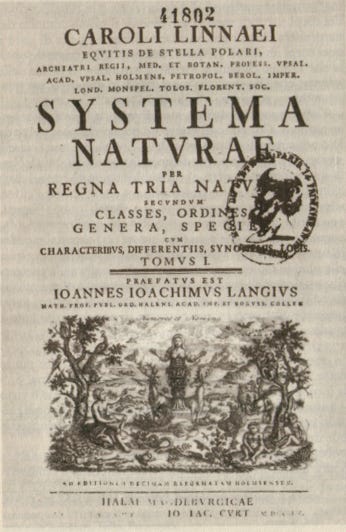
Cover of Systema Naturae — the work that began as eleven pages
Title page of an early edition. The first edition (1735) was eleven outsize pages; by the 12th (1766–68), the work had swelled to roughly 2,400.
A: Professor, they look as though they contain an entire library.
“In a sense, they do, but please just call me Carl. Every page represents a plant examined, an animal described, or a specimen compared with another. Years of observation, travel, and correspondence.”
Frankly, Carl, it seems an impossible labour for one man.
“If I had relied only on my own travels, these books would still be empty.”
He pulls open a drawer and removes a folded sheet containing a dried specimen. He smooths it on the desk between us. “Thea sinensis, the tea plant”, he says quietly.
“This leaf was carried home from Canton by my student Pehr Osbeck, who sailed there with the East India Company more than twenty years ago.
Every cup of tea drunk in Stockholm came from a plant no European naturalist had ever seen growing. We were drinking something we really knew nothing about.”
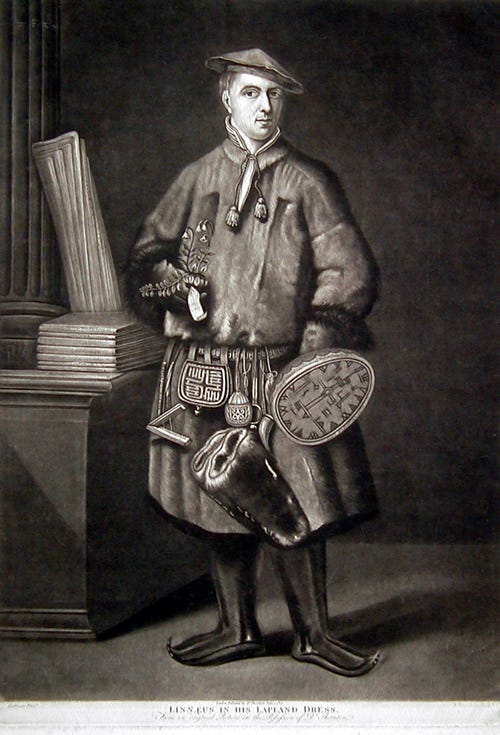
Linnaeus in Sami (“Lapland”) costume, after Martin Hoffman, 1737
Painted in the Netherlands shortly after Linnaeus’s six-month, 2,000-km expedition to Lapland in 1732. He holds his favourite plant, the twinflower; on his belt hangs a Sami shaman drum.
“So the world began to travel to me. My students went out into it. Some sailed with trading companies. Others joined expeditions to the Americas, Africa, China, and the Pacific.
They sent back plants, seeds, insects, skins, and shells, sometimes letters describing species that had never been seen in Europe, sometimes the species themselves. A torrent of information I am still trying to master.”
A: It still seems an extraordinary achievement for one man.
Linnaeus shakes his head. “Then you misunderstand the enterprise. I was not alone.” He gestures toward a stack of letters tied with ribbon. “My students travelled farther than I ever did.” After a pause, almost in a whisper: “Not all returned.”
A; They risked their lives for natural history?
“Exploration was never gentle work. Some died of fever. Some perished at sea. But those who returned brought wonders with them.”
He lifts another letter from the bundle and turns it over thoughtfully. “Let me tell you about one of them, Peter Forsskål.”
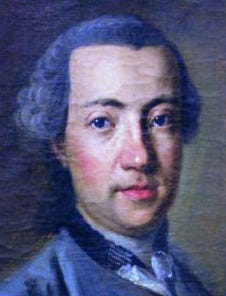
(1732–1763) — “one of my finest students”
Forsskål died of malaria in Yemen, aged thirty-one.
His specimens and notes were brought home and
published posthumously.
“Peter was a brilliant young man, sharp eyes, restless mind. He joined a Danish expedition to Arabia. They sailed south through the Mediterranean and into the Red Sea.
Heat like a furnace. Strange plants, strange insects, creatures no European had properly described. He collected tirelessly, even when the expedition itself began to fall apart.”
A: Falling apart? What exactly do you mean, Carl?
“Disease. One by one, the members of the expedition fell ill. Forsskål himself continued working until he could hardly stand.”
Linnaeus rests his hand on the book. “When you look at these pages, you are not only seeing plants and animals. You are seeing journeys. Storms at sea. Long marches through forests and deserts. And sometimes the price paid by those who went looking.”
A: You say that your system is simple, Carl, but I am still not sure I fully understand it. Take the kangaroo. How does your dual system cope with that strange creature?
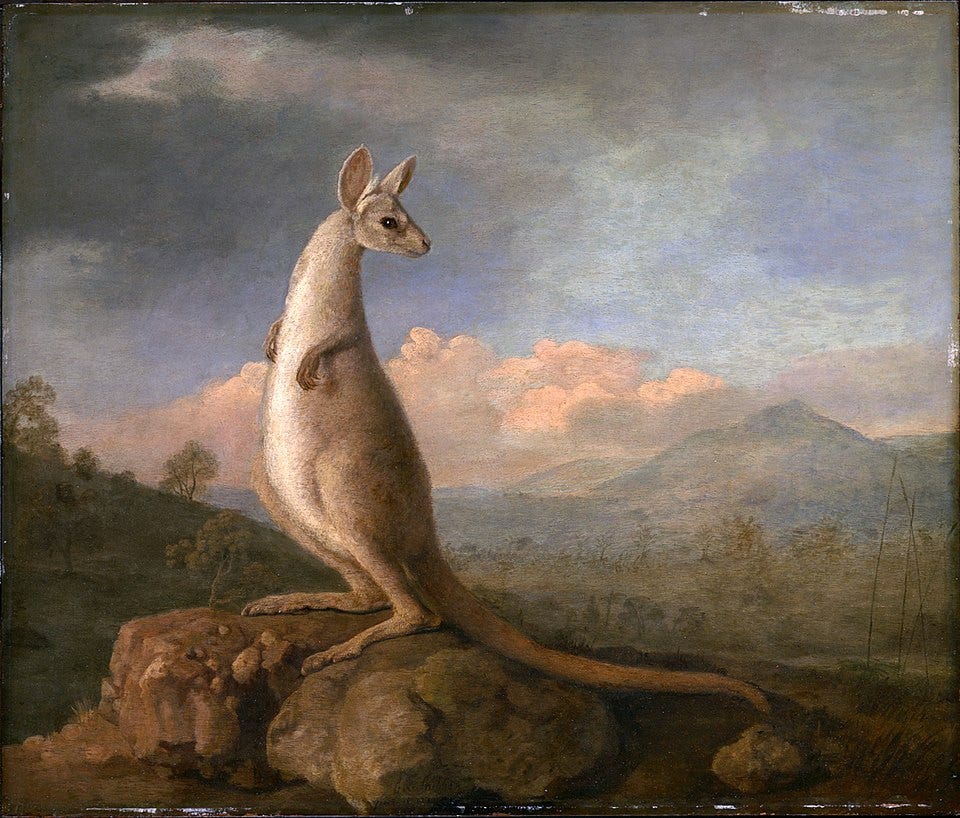
The Kongouro from New Holland, George Stubbs, 1772
First painting of an Australian animal in Western art by Stubbs,
working only from sketches and an inflated pelt.
“You are puzzled by the two kingdoms. Good. That is the right place to be unsure. When you look at a kangaroo, what is the first thing that strikes you as wrong?
You cannot decide whether it is a deer, a rabbit, or something that simply shouldn’t exist. And that uncertainty is precisely what my system is for.
I am asking you to look at it. Just look. Does it move toward its food, or does food come to it through the ground and the light? It leaps, it seeks, it eats. It is no plant. One question, and already we have walked through the first door.
Does it nurse its young with milk? It does. And it has hair, and it is warm. Those three things: milk, fur, and warm blood tell us what kind of animal it is. Not the pouch, not the legs, not the strangeness of it.”
A: You have gone further than any other human being or naturalist. in inventing a two-word system for naming species.
“Kind of you to say so, and it also explains why I have been so busy working here in Uppsala, this city in Eastern Sweden.
A: Yes, and your system remains the language of modern biology. But can we go back a bit, Carl? Tell me about the boy who became Carl Linnaeus. Where did all of this begin?
“In a parsonage garden in Småland. My father was a country pastor, pious, learned in his way, but his great love was the garden behind the house. He had planted it himself, every bed, every border.
When I was small and would not stop crying, he would pick a flower from the garden and place it in my hand, and I would fall silent at once, turning it over, studying it.
I have no memory of a time when flowers were not the most interesting thing in the world to me.”
A; Did your parents want you to follow him into the church?
“Oh, yes. That was the plan. But I was a hopeless schoolboy. I learned what I wanted to learn, the names of plants, the parts of flowers, and I ignored Latin grammar and theology entirely.
My poor father despaired. He was on the point of apprenticing me to a shoemaker when a local doctor, Johan Rothman, took pity on us both. He told my father, ‘Let the boy follow his nature. He is meant for botany, not the pulpit.’
It was a brave thing to say to a country pastor about his only son. I have never forgotten it.”
A: Was there a single moment when you knew this would be your life’s work?
“Lapland. The summer of 1732. I went north on horseback with very little money and a borrowed notebook. Five months alone in a country no botanist had ever properly described.
I returned thin, sunburned, half my clothes in rags, and with a head full of plants nobody in Europe had named.
That was when I understood: the work was endless, and there was room in nature for a hundred lifetimes of looking and naming.”
A; Speaking of naming, you even named yourself: Homo sapiens. You became the man who placed humans among the apes.
A: “Yes, that caused considerable trouble. The clergymen who had wanted me in their pulpits were not best pleased to find themselves classified beside the orangutan.
But I could see no way around it. If I were to look honestly at the body, the hand, the teeth, the bones, then man belonged with the other animals. Homo sapiens. The wise one. Or so we hope.”
A; Carl, when you look at all of this, the volumes, the cabinets, a lifetime’s work, what do you most hope will outlast you?
He is quiet for a long time, then gestures, not at the books, but towards the garden visible through the window.
“Not the names. Names will be revised, expanded, and replaced by others wiser than mine. What I hope outlasts me is something simpler. The habit of looking. The willingness to set a thing on the desk and ask: What are you, truly? Not what I have been told you are. Not what I expected to find. What are you?
If a child somewhere, in a parsonage garden, perhaps, or by a stream in the woods, picks up a flower and turns it over in her hand and wonders, just wonders, then that is enough.
Everything else is just writing down. The world is endlessly worth attending to. That is what I should like to leave behind.”
Linnaeus’s gift was not really the names. Most of his thousands of two-part names have since been corrected or replaced. What survives is the basic architecture: two words, every time. That convention is now the core language of every field guide on the planet.
It is easy to forget how strange that was in 1735. The naturalist’s world before him was a babel of common names, paragraph-long Latin descriptions, and local folk names.
His decision to place man among the primates is the bravest line he ever wrote. Eighty-four years before Darwin, he looked at the hand, teeth and bones, and put us in with the apes.
The clergy were furious, but the classification stuck. It prepared the European mind, slowly, for the much more disturbing claim that would arrive a century later: that we belong with the other animals not only in form but in ancestry.
Linnaeus made looking with great attention respectable. Before him, knowing the world meant reading books. After him, it meant going outside with a notebook.
The image of him on the Lapland heath in his borrowed Sami coat, holding the twinflower, is the prototype of every fieldworker who came after: Darwin in the Galápagos, Wallace in the Malay Archipelago, Goodall in Gombe.
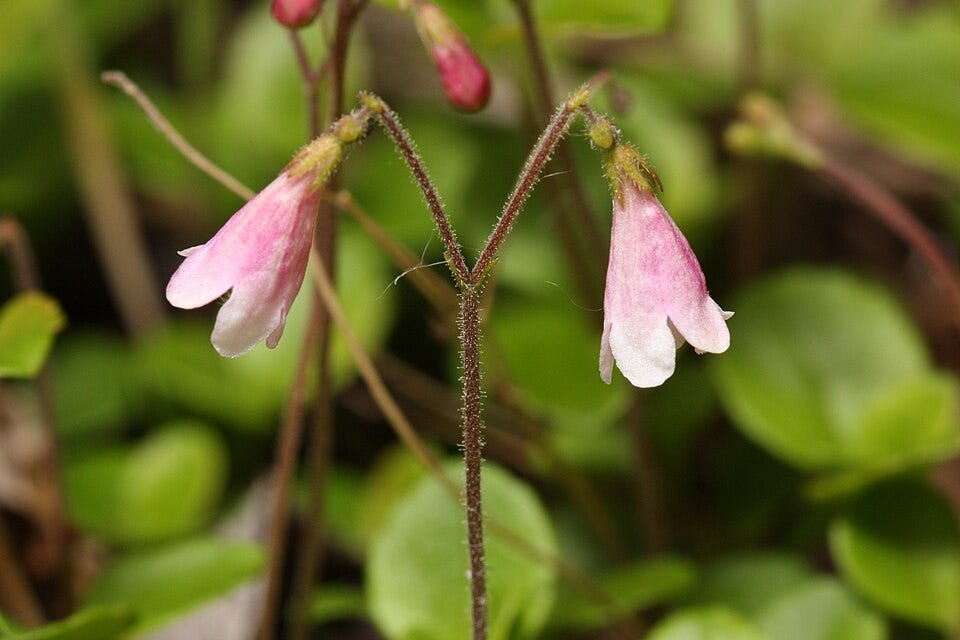
Linnaea borealis, the twinflower,
Linnaeus’s personal emblem
The discipline he taught was patience: examine, compare, name, repeat. And that discipline is still what biology runs on. It firmly established Linnaeus as a Visionary who shaped the future.

This is a version of my conversation with Linnaeus, drawn from my forthcoming book: Conversations with Visionaries Who Shaped the Future.
Subscribe to be notified when the book and the full conversation are published.*
If you have enjoyed this Conversation, you may also like my other Conversations in my books:
Conversations with Remarkable Women
Conversations with Marvellous Muses