
A MAN AT SIMONE
de BEAUVOIR’S FUNERAL

They buried her wearing a silver ring. Not a wedding band, it never was.
At the Montparnasse Cemetery on 19th April 1986, the crowd has thinned to almost nothing.
Sartre went into the ground here six years ago to the day, with fifty thousand people following the cortège through Paris.
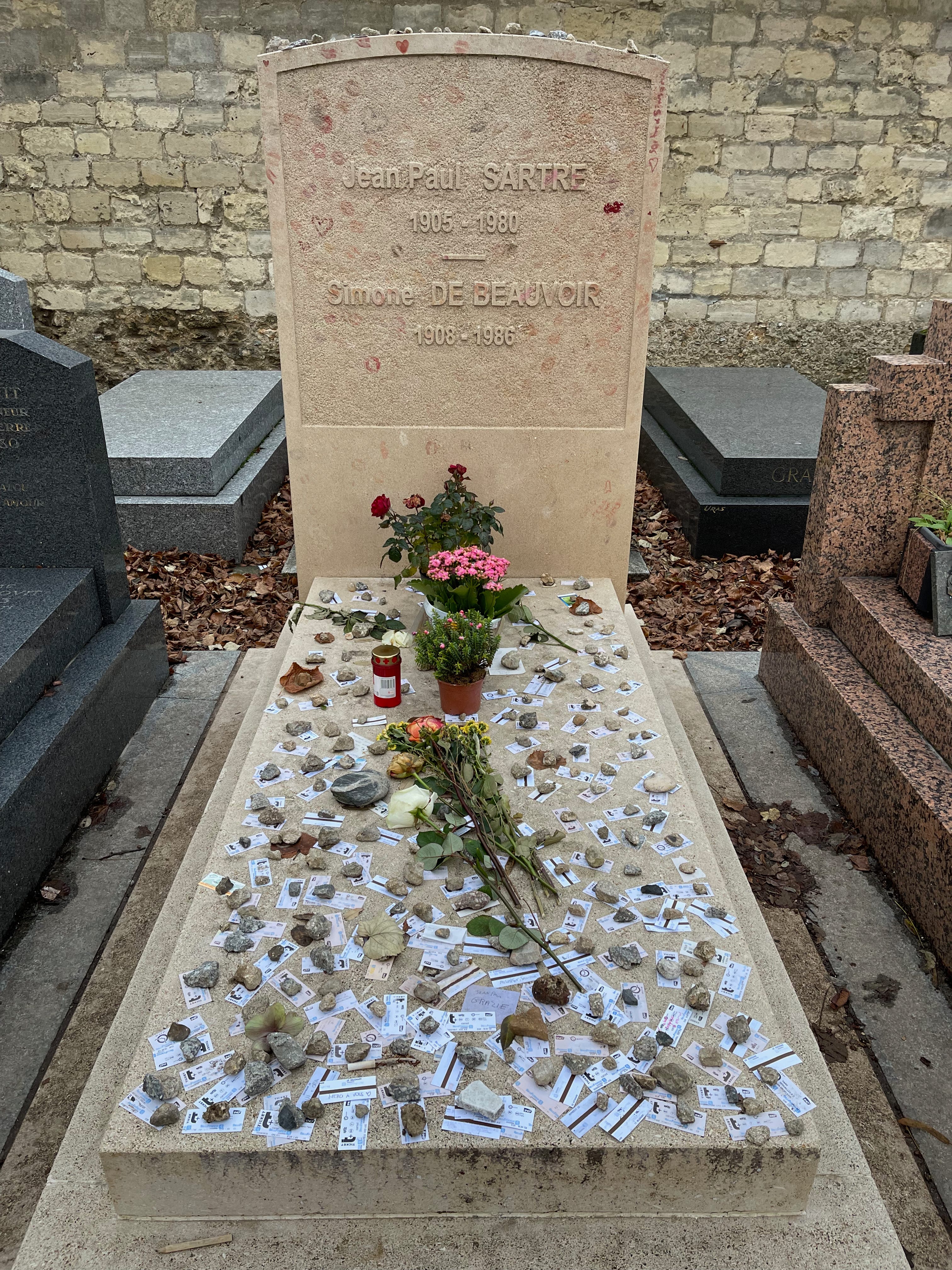

Montparnasse Cemetery
Today’s turnout for de Beauvoir was smaller, a few thousand. Most have already gone.
I don’t like funerals. I especially don’t like this one. So I am standing about, notebook unused in my coat pocket.
I feel like an intruder who has stayed too long when I notice a man with a large handkerchief pressed over his face.
He looks wrecked. I feel I must say something. Are you all right? Anything I can do to help?
He doesn’t answer at first; he just looks at me. Then he stuffs the handkerchief into his top pocket and sounds angry rather than sad.
“They buried her wearing his silver ring given during her first Chicago visit when he was living in two rooms writing about junkies and hustlers.
She wore it the rest of her life, and he never got over her.”
Nelson Algren? The writer?

Nelson Algren
“Yes. And she’s just been buried beside a different man entirely. Now they share a tomb, a magazine, a philosophy and a myth.”
You mean the arrangement, the pact they made in 1929.
“Yes, the pact. It suited him entirely, this Contingency nonsense. A Seducer’s Charter is what I call it.
It was how Sartre justified his multiple relationships with women. Contingency made it sound philosophical, almost normal.
The one between Nelson and de Beauvoir was only ever meant to run for two years. Renewable.
“And they renewed it for fifty. Nelson knew all about that. So do I.”
You knew him well?
“We went back a long way. Chicago, 1947. She was on a tour of America, and he was living hard and writing harder. Within days, they had mistaken intensity for a future.”
So what went wrong?
“Look. If you want to talk about this, let’s get out of this cemetery. Coffee.”

Ten minutes later, we are sitting at a pavement café with two cups between us. The handkerchief is still showing in his pocket. He stirs his coffee as though accusing it of something.
“I’m bitter too, I suppose. It is no fun watching your friend pine for a thing he is never going to get.”
Which was what?
“Exclusivity. He wanted her whole, in one city, under one roof. The arrangement was always going to be in the way.”
And she wouldn’t leave.
“She wouldn’t leave Paris, and she wouldn’t leave Sartre, and she was never going to pull down a life that had been standing since before the war.
So Nelson ended up as the Contingent one. On the wrong side of a line that got drawn eighteen years before he ever met her.”
Necessary and Contingent. Their words.
“Their words about themselves. He just got filed under the second one.”
He could have lived with that, though. Plenty of men have.
He shrugs and gulps the rest of his coffee, now growing cold. “He might have. If it had stayed between the three of them.”
Meaning?
“She wrote it down. First, in the Mandarins, describing the affair, everyone recognised the character Lewis Brogan as Algren.
She even dedicated the novel to Nelson and won the top French literary prize.”
You mean the Prix Goncourt. That made the story not only recognisable but widely read. But still, Algren didn’t retaliate, did he?
“No, he said he could live with the fiction. It was her third memoir, Force of Circumstance in 1963, that blew Nelson’s mind.”
How so?
“She laid out their whole relationship as fact, naming her arrangement with Sartre. She admitted that she had fictionalised Algren in The Mandarins. Poor Nelson was furious. And I could hardly blame him.
It didn’t help that Harper’s ran an extract pointedly called A Question of Fidelity.
But what Nelson hated most was the exposure, not the contingency business.”
I suppose he didn’t like having a private love affair turned into something where he was a contingent, something on the side, as it were?


On the side, that was exactly what Contingency was really about. So Nelson went after her in print. In Harper’s, in 1965, he tore into her, even complaining: “Will she ever quit talking?”
I had never seen him so upset and angry. He kept asking me the same thing. ” Contingent upon what?”
Ugly. Everybody said Nelson lost his dignity doing that article.
“Maybe he had. But you tell me what a man is supposed to do when his one great passion is a famous woman’s life. Then he reads in her own careful prose that he was always the secondary term.
You want dignity after that? Dignity’s a luxury. Nelson was a poor kid from Chicago. Luxuries were the one thing he could never afford.
He was still angry about it when he died.”
In 1981. Right at the end.
“Yes, at Sag Harbor on 9th May 1981. It was on the eve of his induction into the American Academy of Arts and Letters. I was so proud of him.
He did an interview with Weatherby of the Guardian in early May, still sore about de Beauvoir and being written about.
And Sartre? Where does he sit in your account of this?
“Sartre invented Contingency to excuse how he behaved with women. She spent the rest of her life defending it.”
Then why did you come today?
“I came for Nelson. Someone had to. He has been forgotten amid all the fuss. Existentialism, Contingency, being on the side, finding one’s true self, the two of them, and the fame that goes with them.”
He drinks the last of his coffee and stands.
“Nice talking to you. At least there’s one more person who knows how Nelson suffered and how she treated the man she called the love of her life.”
Then he is gone up the street, and I am left with the bill, an empty chair, and the uneasy thought that every great love story depends on who gets to tell it last.

SOURCES
The man at the graveside is invented, and so is our conversation. Yet everything he says, the ring, the pact, the Chicago years, the classification, the memoirs and the fury they caused are all on the record.
She was buried in her red turban, red bathrobe and Algren’s ring. The facts are documented, and the bitterness is his.
Core sources are:
-
Deirdre Bair, Simone de Beauvoir: A Biography (1990): the 1929 pact, its two-year renewable terms, the necessary/contingent distinction, the burial.
-
Bettina Drew, Nelson Algren: A Life on the Wild Side (1989): Algren in Chicago; the affair from his side; the ring; his reaction to Force of Circumstance; his last years and death.
-
Simone de Beauvoir, Force of Circumstance (French edition 1963; English 1965), her own account of the affair, and the book that caused the rupture.
-
Simone de Beauvoir, The Mandarins (1954), the fictionalised version, dedicated to Algren.
-
Nelson Algren’s review of Force of Circumstance, Harper’s, May 1965 — his public attack.
-
W.J. Weatherby, Guardian, May 1981, the last interview, days before Algren died in Sag Harbor.
-
Simone de Beauvoir, A Transatlantic Love Affair: Letters to Nelson Algren (1997), her side of the correspondence, published eleven years after her death.