NICOLAUS COPERNICUS

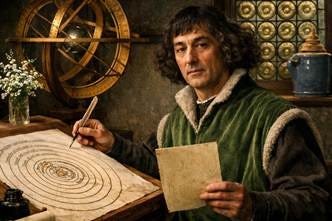
Only a handful of trusted scholars have seen it. Beside his hand lies a slim unpublished manuscript he calls “little commentary” or his Commentariolus.
It is such a modest name for a note that quietly announced the Earth was moving under everyone’s feet, and nobody had noticed.
It is an outrageous claim by the Polish astronomer and Renaissance polymath Copernicus.
My correspondence with him has been successful. He has personally invited me to meet him at his workplace, Frombork Cathedral in northern Poland.
The Earth is not the static centre of things, he claims. It is just one of several planets orbiting the Sun.
So far, he has not published his controversial views. He fears that such a claim might bring him down. So the pages stay here, in the candlelight, above a sleeping town.
The night wind from the Baltic presses against the stone. Salt and distant seaweed follow me up the narrow tower to where Nicolaus Copernicus works long after the town has fallen asleep.
I mount the worn spiral stair into a small chamber beneath the roof beams.The place is half study, half observatory.
A single candle burns beside an armillary sphere…

…and a stack of parchment diagrams. Circles nested within circles. The paths of wandering planets, traced in careful ink.
As I watch, Copernicus finishes a line of figures and blows gently across the parchment to dry it. Only then does he notice me.
His face shows no alarm. Only curiosity. “Welcome. To climb these stairs at such an hour, you must have something interesting to ask.”
Magister Kopernik, thank you for seeing me. You studied in Kraków; what were you taught there about the universe, and did any of it trouble you?
“The cosmology troubled me. We studied Claudius Ptolemy’s work. For more than a thousand years, it had stood as the best account of the heavens.
The Earth rests immobile at the centre. Around it circle the Moon, the Sun, the planets, and the sphere of fixed stars.
To explain certain irregularities, Ptolemy added smaller circles fixed upon the larger ones.
It was ingenious. It let astronomers predict where a planet would appear.
And yet, even as a student, I felt a discomfort I could not name. The heavens looked harmonious.
The more I looked, the explanation of them grew only more tangled.
Each generation was obliged to add another repair. He sets down his pen. The word repair seems to sit heavily with him.
A hard doubt to carry, surely, when those assumptions had stood for centuries?
“Yes. At the tim,e I did not imagine I was challenging anything so large. I felt only that something did not fit.
When a system demands constant mending, it may mean we have mistaken its foundations.
But such thoughts come slowly. A student rarely dreams of overturning antiquity.”
Your early nights of observation used very simple instruments. What did they teach you?
“Patience, above all. One observation tells you almost nothing.
You must watch the same planet night after night, season after season, sometimes across years. Slowly, the patterns show themselves.
Those nights bring humility too. The planets keep their own time, not ours.
When you contemplate such spans, human concerns seem fleeting.
In that sense, astronomy has something of the monastery about it. It teaches silence, patience, attention.”
When did your doubt become something more serious?
“The first was deceptively simple. Each day the heavens appear to wheel about us. The Sun rises, the stars travel from east to west.
But I began to wonder whether that motion belonged to the Earth instead.
If our world were to turn, the movement of the sky could be explained far more easily.
Once the thought entered my mind, I could not dismiss it.
Many puzzles suddenly grew simpler.” He moves a diagram toward the candlelight, the orbit of Mars, drawn in careful ink.
What convinced you that the Earth might truly move?
“The wandering of the planets. Consider the strange backward drift of Mars.
For centuries, astronomers believed it required elaborate machinery.
But if the Earth itself moves along an orbit, the effect is plain.
When our faster world passes a slower one, that other planet seems to slip backwards for a time.
Nothing reverses at all. It is our own shifting position that deceives the eye.
Once I saw this, the whole arrangement of the heavens felt transparent. What had looked like disorder was order all along.”
What seemed chaos from one angle became order from another. Is that what you mean?
“Just so. The universe is often simpler than our accounts of it. It is our vantage that complicates matters.”
When the idea first came, did it feel like discovery or like heresy?
“At first, there was the uncertainty. When a new idea appears, the scholar’s first duty is to doubt it. I repeated my calculations many times, hunting for the error.
Each time, the same conclusion was returned. Only later did I understand how radical it might seem to others.” He falls quiet and in the silence the candle gutters.
Magister Kopernik, it is one thing to adjust a theory. Quite another to move the Earth.
“I did not think of it so grandly. I sought the arrangement that best made sense of the observations. If moving the Earth achieved that, then the Earth must move.”
You also hold that the Earth turns each day. What evidence persuaded you?
“If the entire sphere of stars swept round us every day, it would race at a speed beyond anything we witness in nature.
It is far more reasonable that the Earth itself turns.
One motion of our world explains the daily rising and setting of the stars, without forcing the whole heavens to whirl about us.”
Yet you have kept these ideas to yourself for years. Why do you hesitate?
“A theory that alters the structure of the heavens should not be announced lightly.
A mistake in such matters could mislead generations. And ideas that unsettle old beliefs are not always welcomed.”
Is that the caution of the scholar, or of the churchman?
“Both, perhaps. A new cosmology touches philosophy, theology, and science alike. I owe it a stronger argument before I expose it to the world.”
You have served the Church much of your life. Do you feel your claim challenges faith?
“No. I seek a clearer understanding of creation. The order of the heavens has always been. We merely try to describe it.
To correct a mistaken description does not diminish the Creator. It honours the design more faithfully.”
So tell me, what does it do to a person, to learn the Earth is not the centre of all things?
“It humbles us. Yet humility can deepen understanding.
If the Earth is a planet among many, then the universe is larger and more magnificent than we dared imagine.”
The candle burns still lower. Beyond the narrow window, the winter stars move slowly across the sky.
For one who glimpses a truth the world is not ready to accept, what would you say to it?
He looks out toward the silent stars. “Be patient. Test your idea carefully. Nature does not change to suit our expectations. We must change to understand nature.”
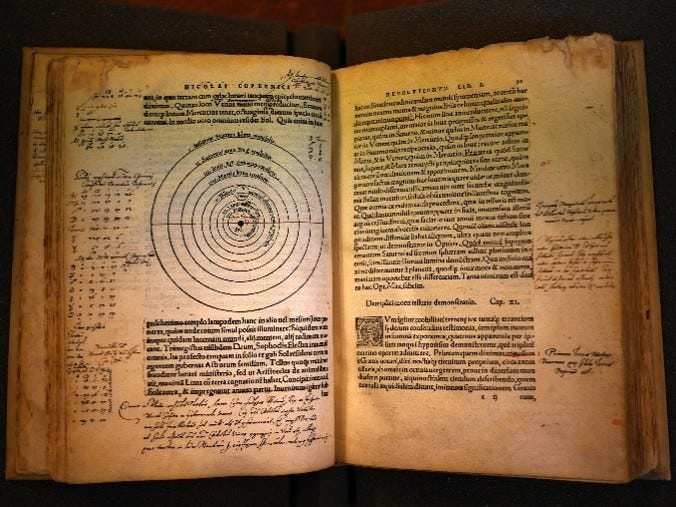
The Copernican System: A Detailed Synopsis Perspective
PERSPECTIVE
Copernicus moved the Earth from the centre of the cosmos and set the Sun there instead.
His revolutionary ideas were published only in 1543, near the end of his life.
The idea was more than an astronomical adjustment. It unseated humanity’s oldest assumption about its own place in creation.
The consequences ran forward through Galileo, Kepler, and Newton. Each was built on the insight to reach planetary motion, gravity, and the shape of the universe.
Copernicus showed that a belief held for a thousand years could yield to evidence and reason.
That was the quiet beginning of the modern scientific mind. It still shapes how we look at the sky.

I write imagined conversations with history’s most remarkable figures: women, Visionaries, and creative minds. Not summaries, but actual encounters. Real lives, reimagined in dialogue.
If you’ve ever wanted to hear the past answer back, you’re in the right place. I call it History Speaks.
Thanks for reading! Subscribe for free to receive new posts and support my work.
A full-length imaginary conversation with Copernicus is included in a new book by Andrew Leigh on Visionaries Who Shaped the Future. To be notified when this book is available click on the subscribe free button below.