
News of a vaccine against Melanoma, announced on 20th August 2026, allows History to remind us how far we have travelled to reach this once distant prospect.
Just over four hundred years ago, in 1612, Prince Henry in England was dying. So naturally, the best physicians attended his highness. Some six of them, nothing but the best for Henry.
Since they didn’t have a vaccine, they ordered tisanes and broth. No joy. Next, they tried a laxative more acceptably called a purge, followed by an enema. Still no joy, and not much fun either for poor Prince Henry.
Being physicians, they invented further possible remedies. They tried that old unreliable favourite, bleeding. That got results. The unfortunate prince became even weaker.
They even administered a panacea sent by Sir Walter Raleigh. He happened to be imprisoned in the Tower of London at the time and hoped it might help his cause.
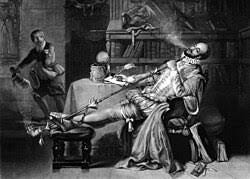
Sir Walter Raleigh in the Tower of London,
1603–1616 by J. Jackson, dated 1836.
Not only did it not get him out of prison, but it didn’t do much good for Henry either.
Despite the best medical minds at the time, there was no improvement in the patient, and the physician cohort was running out of ideas.
None of course said: “If only we had some kind of vaccine”, since it took a few hundred more years for even the first vaccine to arrive.
So they tried birds. They killed a few pigeons, shaved Henry’s head, and laid three dead ones on his bare bonce.
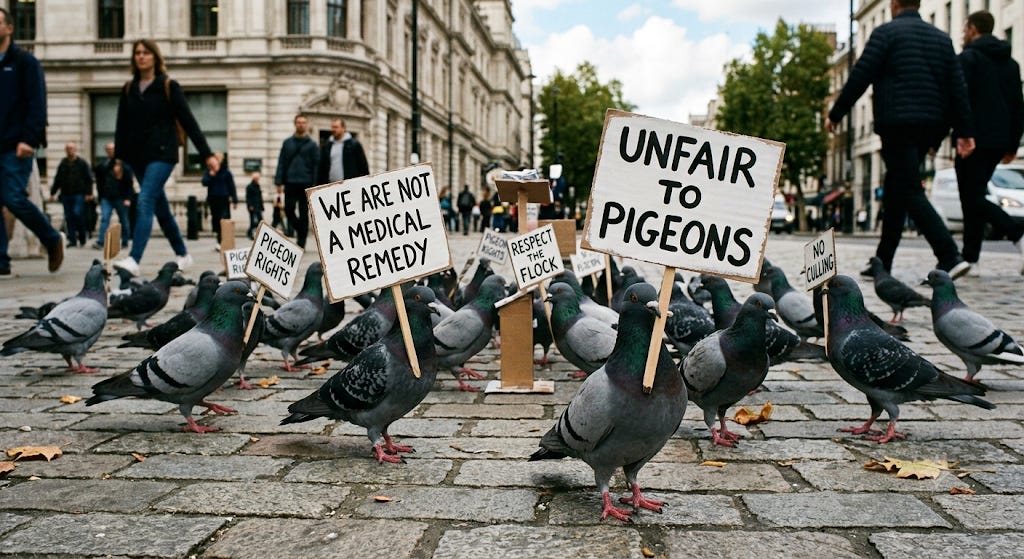
Still no joy, although it’s entirely possible that it triggered in Henry a potential allergy to pigeons.
One or more of the prince’s expensive medical team members suggested a bright idea to justify their expensive fees. The brilliance of this was breathtaking.
Kill a cock, slitt it down the back, and apply the dead creature to Henry’s feet.
“That should do it “ we can imagine one of the medics saying, meanwhile keeping his fingers crossed.
Sure enough, this curious remedy did do it. Henry died two days later.
The physicians of 1612 tried everything and found no joy. In August 2026, a melanoma vaccine offers something they never had: a reason to expect joy.
Four centuries separate the dead cock from the clinical trial. That gap is the measure of how far we have come, and Prince Henry, for what it’s worth, would have swapped every pigeon on his head for a single dose
[Seventeenth-century treatment regime, suggested in Scape Goat by Lucy Hughes-Hallett, 2025.]