IBN AL-HAYTHAM (ALHAZEN)


It is 1017, and the sharpest mind of the age is pretending to be mad.
Ibn al-Haytham sits in a small house on a narrow Cairo street. He is in his fifth year of arrest.
The Caliph had summoned the Iraqi mathematician, physicist, and astronomer to address the Nile’s flooding. Too ambitious, he promised the Caliph he could do it; he failed.
The technology of his century was never going to be enough. A ruler’s disappointment can be fatal.
So the great man now feigns insanity, and the guards leave him alone. That is the bargain. Dignity and silence, traded for time without interference.
I have been granted rare permission to visit. My excuse is to copy manuscripts.
Scarred by years of use, the wooden door to the house of confinement opens grudgingly and never fully.
Inside there is no grand courtyard. Only a small space that admits light reluctantly, as though hoarding it.
The room I am to meet the father of modern optics is undecorated. It is instrumented.
Bowls of water sit along the walls beside polished metal, glass, and many small darkened boxes draped in cloth.
Nothing here is ornamental. Everything either admits, blocks, or bends light.
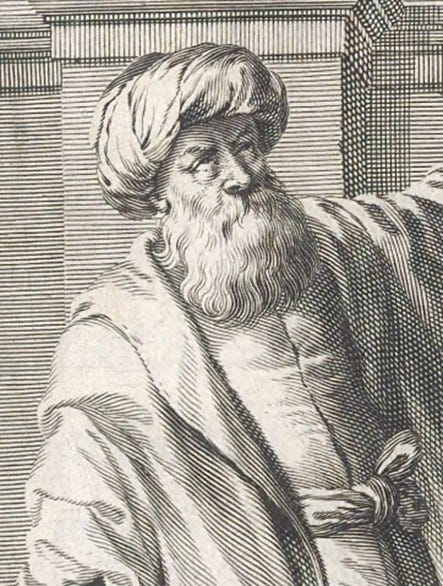
A man in his early fifties is adjusting a cloth over a window. His build is slight. His robe is clean but worn, dulled by repeated washing.
The luxurious public turban is gone. This is the Visionary I have come to meet, and he is dimming his own room on purpose.
He takes a seat across from me. His eyes find mine at once, appraising how the light moves over me.
Yā ustādh, Abū ʿAlī, I have come to learn about your writings. They are prolific and important.
He nods, still wary, not unfriendly. He speaks calmly, no urgency in his voice, only precision.
“And how may I help my visitor? I have so few of any kind these days.”
There is fatigue in him, but no despair. This is not a man seeking recognition. It is a man who has decided that being correct matters more than being seen.
You were brought here as an engineer, expected to achieve great things. Now you are confined to silent labour. Is that defeat?
“No. When I attempted to control the Nile, I was conspicuous. It was a fancy kind of arrogance. Here I command nothing. I observe. It is slower work, but it is cleaner. What I give up in reach, I get back in accuracy.”
You feign madness to survive. What does this mask of pretence cost you?
“Dignity and silence. They buy something more valuable. Time without interruption. Behind the madness, I am free to think. The cost is real, yet the exchange is fair.”
He stands and moves to the covered window. “Come. Let me show you.”
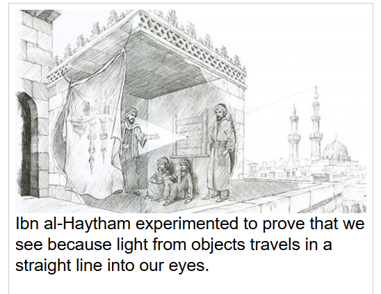
He slides aside a covering over a small hole in the wall. A thin beam enters the darkened room and throws an image onto the opposite wall. “What do you notice?”
It is upside down. Reversed.
“Well seen. And sharp, not smudged. A point outside maps to a point inside. The world does not spill in here. It arrives disciplined. That alone challenges centuries of presumption.”
AbūʿAlī, put it simply, how do you interpret the reversed image?
“A record of what changes and what does not. Light reflects at equal angles. It bends as it enters water or glass. These behaviours repeat, every time I open that hole.”
Why should the world beyond this room care?
“Because people confuse sensation with reality. They trust what they see more than the cause of it. If we understand how light works, we learn how easily we are fooled.”
He picks a yellow fruit from a bowl and holds it in the beam, then lowers it into shadow.
“Watch. The brightness falls, but the colour seems to hold. The mind remembers the colour and expects to see it again. That expectation is useful. It is also a perversion.”
AbūʿAlī, are you saying the fruit tricks us?
He cannot suppress a delighted chuckle. “Not the fruit. The mind. It aids us and misleads us at once.”
This is his real discovery. Vision does not end at the eye. The eye is only a door.
What passes through is shaped in the mind, which organises, corrects, and guesses. It fills gaps. It smooths what is uneven.
So while we believe we see the world directly, in fact we really see a version, built at speed, is that right?
“You are correct. And with speed comes confidence, and error hides behind confidence.” He rises slowly, as though afraid to disturb the silence that has become his companion.
From a low chest rubbed smooth by years of use, he brings out a plain clay jug and two unglazed cups.
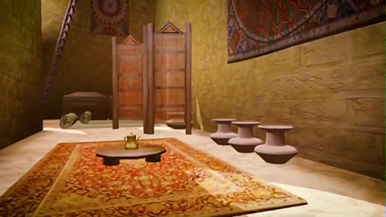
He pours, sets down dates, dense barley bread, and small cakes. Then he tears the bread and hands me the larger piece.
He does not speak while we eat. The silence is not uncomfortable. In a life ruled by thought, it reads as friendship.
Tell me, AbūʿAlī, if our senses are so unreliable, can we know anything at all?
“Another fair question. We must rely on testing, not trust. One sense corrects another. Repetition corrects impulse. Geometry corrects intuition.”
I see. Your shelves here are full of Greek and Arabic authorities. Yet you actively write against them. Why is reading not enough?
“Because books disagree with the real world, yet I respect the great writers.
But when their explanations fail under testing, I cannot defend them. I do not challenge the men. I challenge their claims.
When the world does not agree, loyalty must shift from the page to the evidence.”
To live here like this, working away on your own, what rules do you impose on yourself?
“I change one thing at a time. I repeat what seems obvious. Most of all, I assume I am wrong until the evidence stops me. It is an awkward position. It guards against self-deception.”
Some will call you a founder, even a father, of a new way of knowing. What do you make of that?
“Founders command loyalty, and loyalty discourages questioning. I would rather be right than venerated. If anyone remembers me, let it be as someone who raised questions, not one who insisted on conformity.”
That is a most modest and noble aspiration, AbūʿAlī; what keeps you going?
“The knowledge that the world can be known more honestly than it is. That responsibility does not vanish because I am confined. If anything, it becomes clearer.”
PERSPECTIVE
Ibn al-Haytham (965-1040) wrote a famous Book of Optics.
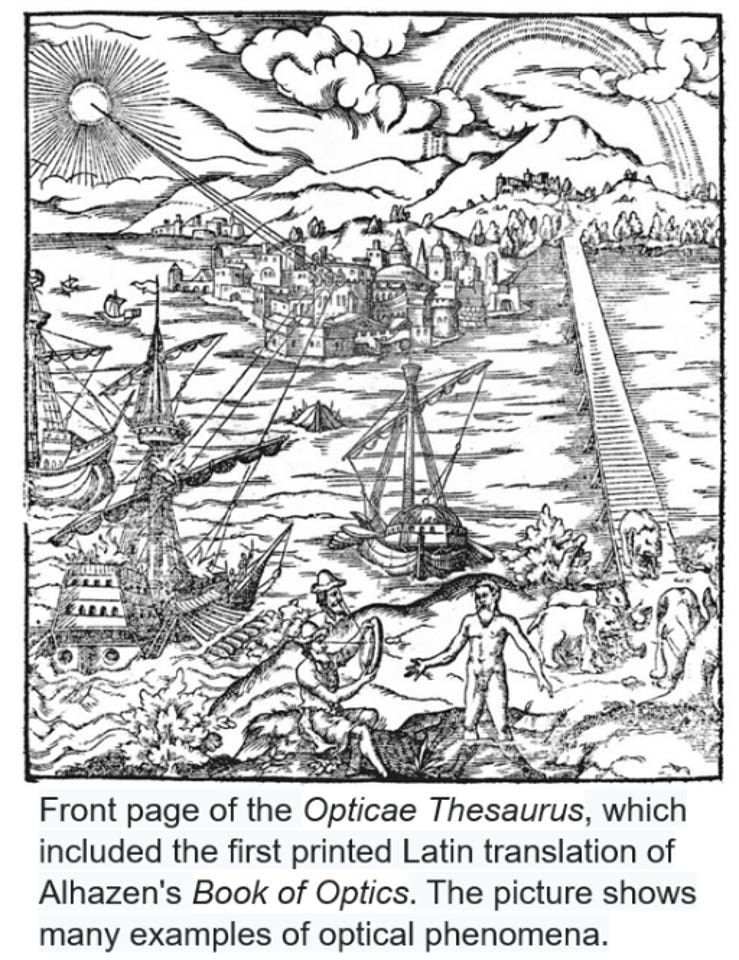
It crossed into Latin as De Aspectibus and reached the scientists Roger Bacon, then Kepler, and the men who built the science that followed.
The Iraqi scientist showed that light travels in straight lines, that reflection holds equal angles, that refraction obeys testable rules, and that images through a small aperture arrive inverted.
He insisted a model must answer to the real world, not merely satisfy the mathematics.
The Caliph forgot him. The method did not. Of all the explanations he asked but one question that has long outlived the house in which he was locked.
Not, is that explanation admired? He did not care. He asked,
“But does it survive an encounter with the world?”