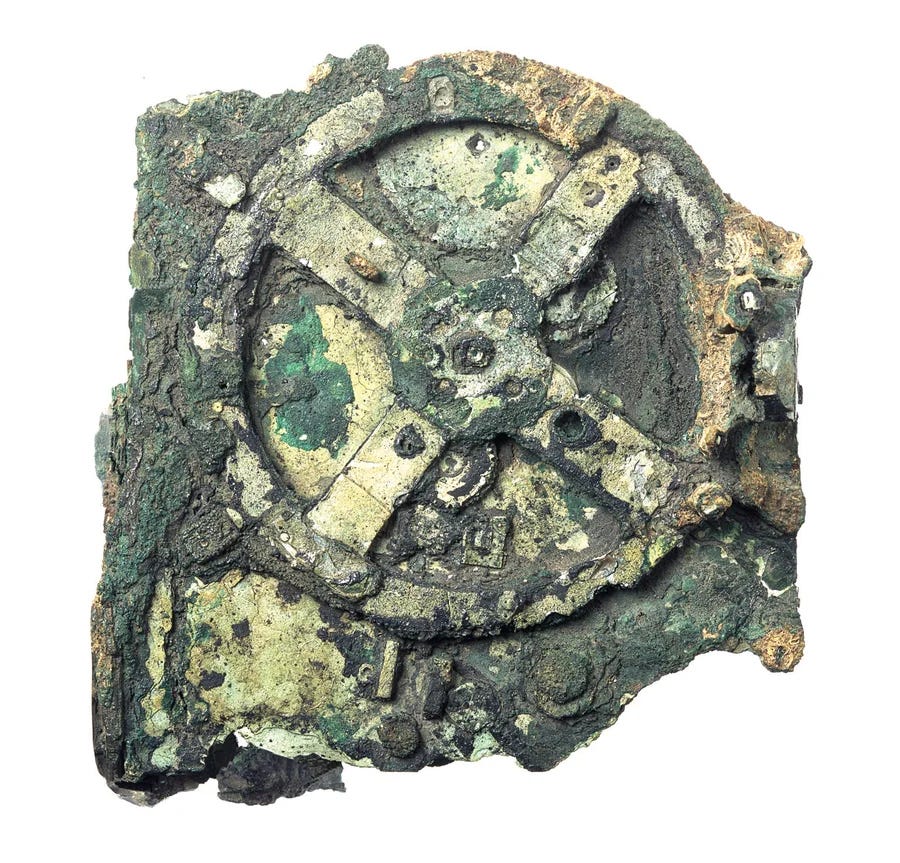
Somewhere on the floor of the Aegean Sea, a wooden case the size of a shoebox is about to begin its two-thousand-year wait. Inside it, thirty bronze gears, each one cut by a man who understood the cosmos well enough to make it turn. I am visiting the Greek Island of Rhodes around 100 BC.
In a workshop on the island, a craftsman is finishing a machine that positively should not exist.
Somehow, it will model the movements of the sun, moon and planets. It will predict eclipses decades in advance. It is being made for a prince who wants the universe on a shelf. It will end up on the floor of the Aegean Sea.
The workshop smells of metal and lamp oil and something sharper underneath, the deep concentration of a mind that does not stop.
He is not a youth, yet his hands are those of a young man: quick, precise, habitually useful. On the bench before him sits a box with its lid open. Inside, an elaborate system of bronze gears so fine they might have been made for gods to read by. He does not look up when I enter.
“Close the door,” he says. “The dust is my enemy.”
I close it. He holds a gear between two fingers, tilts it toward the lamp, and sets it down.
“You have come to see the machine.”
A: If you’ll show me.
“Everyone wants to see it.” He does not sound flattered. “No one understands it.”
A: Try me.
He looks up then, assessing. He has the focused, slightly impatient expression of a man who has explained things too many times to people who were not listening.
“It is a model of the cosmos,” he says. “Turn this crank,” he indicates a small handle on the side, “and the heavens move. The sun advances through the zodiac. The moon shows its phase. The five wandering stars, Mercury, Venus, Mars, Jupiter, and Saturn, take their positions in the sky.”
A: For any date?
“Past or future. Turn forward, the sky advances. Turn back, it retreats.” He pauses. “Two thousand years from now, if the gears survive, a man could set it to his own birthday and read the sky above his birth.”
A: And at the back?
He turns the case. Two large spiral dials fill the rear face.
“This one”, his finger traces a nineteen-year spiral, “is the Metonic cycle. Nineteen years before the moon returns to the same position on the same day. Useful if you are a priest. Useful if you are a farmer. Useful if you want to know when the Olympic Games will fall.”
A: And the other?
“Eclipses. Solar and lunar. The Saros cycle lasts 223 months. Predict them to the hour.” He closes the case with the care of a man handling something alive. “The Babylonians tracked this in clay for centuries. I put it in bronze. I made it turn.”
I look at the case. Perhaps thirty bronze gears producing accurate astronomical calculations is simply without parallel in the ancient world. Nothing else remotely like it survives, and nothing comparable appears again for over a thousand years.
A: How many men in the world could have built this?
He considers it honestly. “In this generation? Perhaps three. Maybe two.”
A: And you have built it for?
He makes a small, dry sound. Not quite a laugh. “A prince,” he says. “A young man of considerable wealth and considerable curiosity and”, he chooses the word carefully, “considerable impatience with things he cannot hold in his hands.”
A: A patron of astronomy?
“A collector of mechanisms.” He picks up a small tool and sets it down again. Nearby, I notice he has a singing bronze bird that opens its beak on the hour. He has a water clock that plays music as it empties.
“My sponsor, my Prince that is, he wants the universe on a shelf beside it.”
A: And you made it.
“Well, I was paid to make it. I also happened to want to make it. That is a fortunate coincidence, and I am not fool enough to refuse it.”
A: Does this sponsor, this young prince, understand what you have crafted?
The craftsman looks at me steadily. “He understands that it impresses his guests. He will turn the crank, and the dials will move, and men will lean forward with their wine untouched. That is enough for him.”
A: But not for you.
“I built into it,” he says quietly, “every astronomical theory of any precision known to this age. Hipparchus on the moon’s anomaly. The Babylonian eclipse cycles. Planetary periods, no Greek before me had ever mechanised.
I have incorporated things that took centuries of watching the sky to understand.” He touches the case once, lightly. “I made them turn together.” Correctly. At the same time.”
A: And it works?
He is quiet for a moment, then shrugs. “It works as the heavens work. Which is to say, mostly. With errors that accumulate. With small imprecisions that the cosmos itself does not bother to correct.”
“I am a craftsman, not a god. The gears are hand-cut. The teeth are triangular. Over time, they will drift.”
A: And when they do?
He picks up the case and holds it for a moment before setting it down for the last time.
When they do,” he says, “whoever finds it will still know that someone, once, thought the universe was worth the effort. Found ways to make mechanisms work that no one has even conceived of today. That is my reward.”
A: And now? Replacing the mechanism in its wooden box, he closes the clasp. “And now tomorrow it goes by boat to my Prince. Let’s hope it arrives safely.
It never arrives at its destination. Somewhere between the Aegean and Italy, it sinks in a storm. The mechanism will sit on the seafloor for 2,000 years. There is no one left to explain it.