Substack is a great place to read about history. Some of our writers really bring the past alive.
In the age of AI, these craftspeople capture our attention in imaginative, creative ways. If you’re one of them, I’m glad to be in your company.
I do hope, though, that you’re not one of the far too many History Abusers. These are so enamoured with the past that they assume the rest of us are equally obsessed.
You can spot a History Abuser right away. They churn out endless unbroken columns of fact-filled information about some event that has caught their imagination.
They seldom pause to tell us why it matters today. Instead, many believe that describing the event is enough, that it should be enough to justify a blog.
The result is all too obvious: a futile reproduction of what you’d find in any history book of substance.
I read this graphomania or verbal diarrhoea with a sinking heart. I long to take the misguided geek aside and make them read their dreary outpouring aloud. If that does not exhaust them, I would ask one simple question:
“What do you think about this event that justifies the column inches? Not what the textbook says. Not what AI says. What do you say?”
History Abusers come in a variety of guises. Do you recognise any of these?
The Date Dropper believes a year is an argument. They string dates together as though chronology alone explains causation. This abuse mistakes a timeline for a thought.
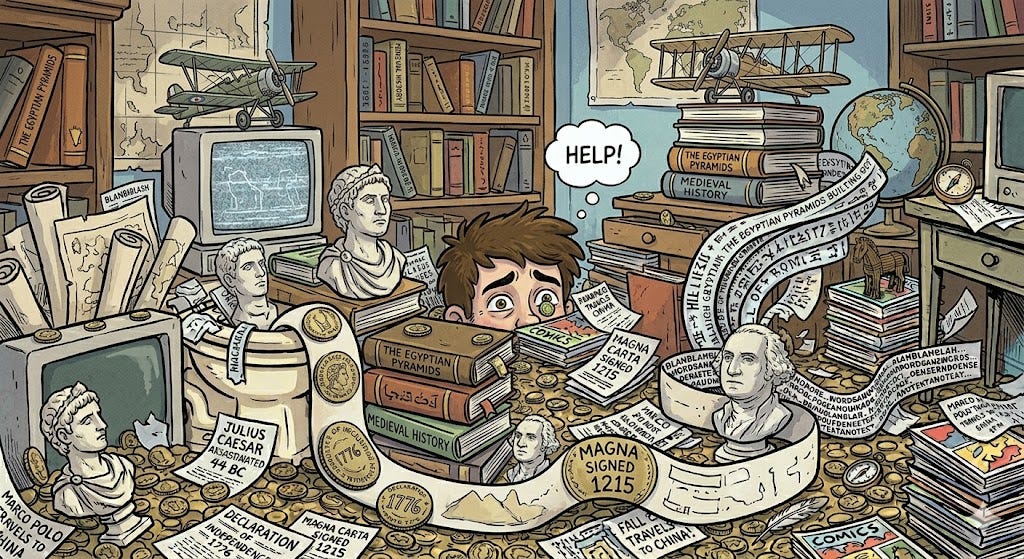
The Trivia Hoarder latches onto curiosities the way a magpie collects foil. Napoleon’s height, the length of a siege, what someone ate for breakfast. Fun for thirty seconds, forgotten in sixty. Confuses the surprising with the significant.
The Costume-Drama Romantic is so in love with the pageantry that the people vanish. Everything is what it was like then, “glittering courts” and “doomed romances.” History is reduced to a theme park.
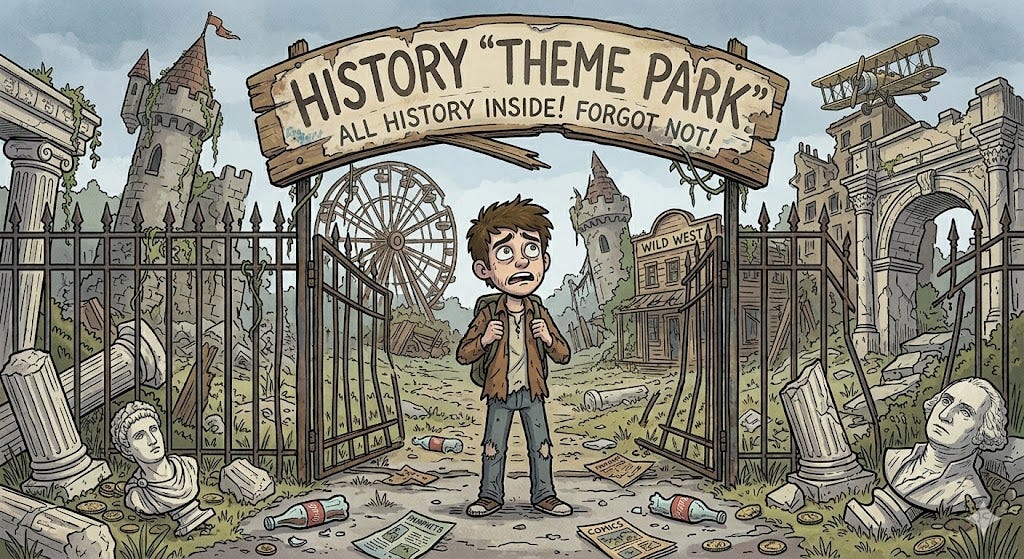
Surely that must be interesting, the abuser hopes? But attendance at a theme park soon wears thin.
The Wikipedia Launderer is the least subtle History Abuser in the AI age. This Substack supplier offers a prompt, lightly reshuffles the output, and presents it as craft.
The giveaway of the Launderer is the prose. Though confident, it is frictionless, yet utterly without a pulse, or even a pause. You can be sure that no human hesitated over a single sentence.
The Moraliser is determined to extract for you a Lesson For Today. For the Moraliser, the past becomes a hand puppet.
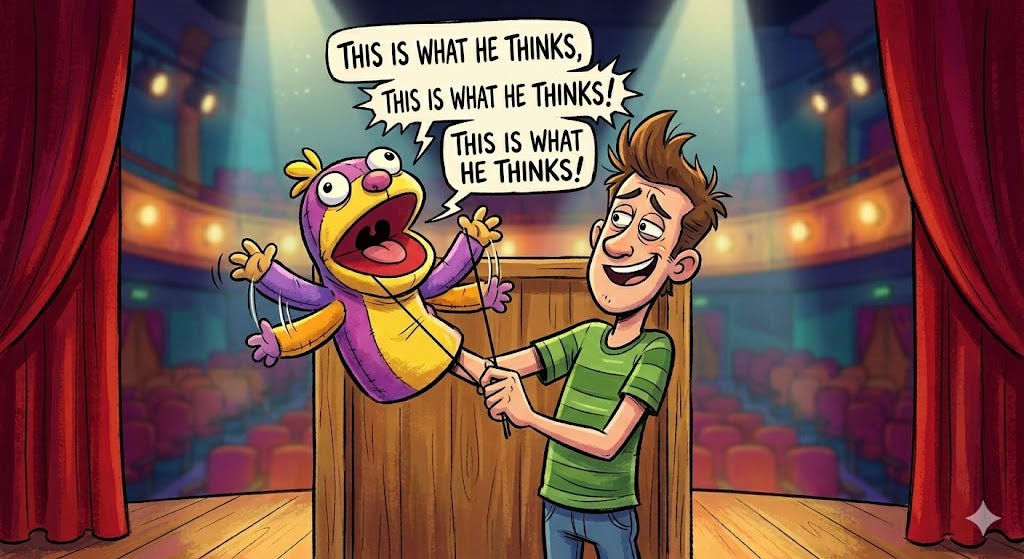
It mouths whatever the author already believes this minute. No real thought, just assertion.
Here’s the uncomfortable reality of being a History Abuser. If you can’t tell the reader something they didn’t already know, or can read for themselves in a history book, you haven’t shared a good story, or offered much of value.

You have moved the text from one bookshelf to another and switched on a light.
Facts don’t glow just because you admire them. That’s not history writing. That’s not historical research. That’s…rearranging.

Here are some questions for you as the reader! Share your thoughts and comments here.
Have you ever woken up with something, a line, an image, a solution that felt like it wasn’t fully yours? Where do you think it came from?
-
Kekulé saw a snake seize its own tail and solved benzene’s structure. Has an image from a dream ever solved something you were stuck on while awake?
-
McCartney thought he’d stolen “Yesterday” because it felt too finished to be new. Have you ever distrusted your own idea for the same reason?
-
Do you keep a notebook by the bed? If not, what’s the best idea you’ve lost to morning?
-
Ramanujan credited his results to a goddess who showed him the maths. If you strip the mysticism out, what do you think was actually happening in his mind at night?
-
Elias Howe dreamt of spears with holes near the tip and solved the sewing machine needle. Has a completely unrelated dream image ever mapped onto a real problem for you?
-
Coleridge lost the rest of “Kubla Khan” to a knock at the door. Has an interruption ever cost you something you couldn’t get back?
-
If your dreams are “test drives for ideas,” as Jung thought, what’s your mind rehearsing lately?