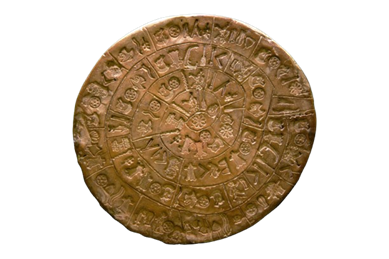
In a palace on a Cretan hillside, a man is kneeling on the floor. In his hands, a clay disc pressed with symbols no one has ever read. He is deciding where to put it, and whether, in doing so, he is preserving something or simply delaying its disappearance.
A palace official in Minoan Crete has been given a clay disc pressed with symbols no one can read. He has been told to seal it into the floor. He does not know why, but seals it anyway.
The palace at Phaistos sits high above the Mesara plain, and the air here smells of cedar and ash and something else, the particular stillness of a place that knows it is running out of time.
The official is waiting as if he expected me. He is not a young man, but he carries his age with the particular certainty of someone who has spent a lifetime managing what others cannot see coming. He gestures to a seat without speaking. I take it.
“You have come about the disc,” he says.
A: Yes.
“Then you already know too much.” He says it without menace, as observation.
A: I know it exists. I know it is sealed into the floor.
“Good.” He folds his hands. “Then we begin where most people end.”
The room is cool and high, ceilinged, with light coming from only one side. Somewhere below us, the palace breathes its ordinary afternoon, grain being counted, oil being measured, the small accountancy of a civilisation that believes it will continue.
A: What does it say?
He looks at me with something between amusement and sorrow. “That is precisely the wrong question.”
A: What is the right one?
“Why, it must not be read.”
I wait.
“The disc was made here by a man whose name I will not speak in this room. The symbols are his. The arrangement is his. Both sides, pressed in a spiral, inward on one face, outward on the other. As if the meaning circles something without arriving at it.”
A: Circles what?
“That is what he would not say.” The official’s eyes move briefly to the floor. “He came to me when it was finished. He said: This must go into the floor of the west court, under the threshold. It must not be copied. It must not be shown. It must not be broken.”
A:” And you asked him what it meant.
“Of course.”
A: And?
“He said: it means what it needs to mean and when it needs to mean it.” The official pauses. “I had him questioned. Thoroughly. He did not change his answer.”
A: You believed him?
“I believed he was telling the truth as he understood it. Whether he understood it fully”, a small gesture, neither confirming nor denying, “that is another matter.
A: Could it be a record? An account? Your people keep meticulous records.
“Our records are in Linear A. Linear A is the writing system we use. It is used for our administrative records, inventories, and accounts.
We know what Linear A looks like. This is not it.” He shifts slightly. “These symbols, there are forty-five distinct signs. Pressed with stamps, not scratched. Each one is deliberate. Repeated in patterns that suggest grammar, or ritual, or something that sits between them. Or something for which we have no word.”
A: Could it be religious?
“Possibly. Our priests have looked at it. Two say it is sacred. One says it is dangerous. One said it was neither and would not explain himself further. He left the palace the following week and did not return.”
A: Why the floor? Why seal it under a threshold?
For the first time, he is quiet long enough that the silence becomes its own answer.
“There are things that must be preserved without being readily available. A threshold is crossed ten thousand times and never examined.” He pauses. “The disc will outlast this room. It will outlast me. It will outlast,” something crosses his face that he controls immediately, “a great deal, perhaps.”
A: You expect the firesA: Why the floor? Why seal it under a threshold?
For the first time, he is quiet long enough that the silence becomes its own answer.
“There are things that must be preserved without being readily available. A threshold is crossed ten thousand times and never examined.” He pauses. “The disc will outlast this room. It will outlast me. It will outlast,” something crosses his face that he controls immediately, “a great deal, perhaps.”
A: You expect the fires.
He does not deny it. “I expect what the sky and the sea have been suggesting for some time. We are not the first palace on this hill.”
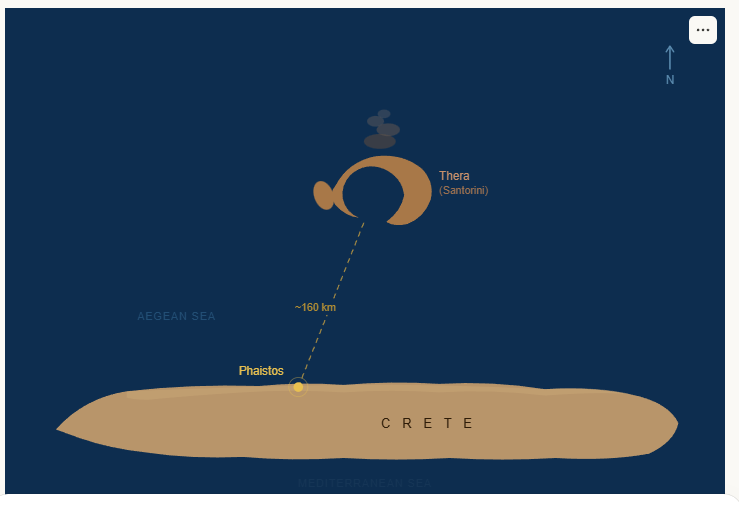
The Volcano Thera, and where the disk was buried
A: And your records? Everything in Linear A — the accounts, the inventories?
“Also lost.” He says it without drama. “We write everything in a script that future hands will not be able to read. The disc is not an exception. It is a summary.”
A: Then why preserve it at all? Why fire it deliberately when everything else will burn anyway?
“Because firing it was a choice. Everything else will survive by accident, if it survives at all. This one I am making permanent on purpose.” He pauses. “There is a difference between what time takes and what you give it.”
A: But you will let it be forgotten.
“Forgotten is not the same as lost.”
A: It may be, if no one can ever read it.
“Then it will wait until someone can. Do you know what I think it is?” he says. It is the first time he has volunteered any personal view.
A: Tell me.
“I think the disc is a question. Not an answer, not a record, not a prayer. A question pressed into clay by a man who did not know who would receive it or when.” He looks at me directly. “Some questions are too large for the people alive when they are asked. They must be sent forward.”
A: To whom?
“To whoever is ready.” A pause. “Perhaps to no one. Perhaps that is also an answer.”
A: And if it is never read?
He considers this with genuine attention, as if the thought is not new, but the weight of it is.
“Then it will have done what all serious questions do when the world is not yet ready for them, it will have waited without complaint.”
I expect what the sky and the sea have been suggesting for some time. We are not the first palace on this hill.”
A: And your records? Everything in Linear A, the accounts, the inventories?
“Also lost.” He says it without drama. “We write everything in a script that future hands will not be able to read. The disc is not an exception. It is a summary.”
A: Then why preserve it at all? Why fire it deliberately when everything else will burn anyway?
“Because firing it was a choice. Everything else will survive by accident, if it survives at all. I am making this one permanent on purpose. There is a difference between what time takes and what you give it.”
A: But you will let it be forgotten.
“Forgotten is not the same as lost.”
A: It may be, if no one can ever read it.
“Then it will wait until someone can.”
“Do you know what I think it is?” he says. It is the first time he has volunteered any personal information.
A: Tell me.
“I think the disc is a question. Not an answer, not a record, not a prayer. It is a question pressed into clay by a man who did not know who would receive it or when.”
He looks at me directly. “Some questions are too large for the people alive when they are asked. They must be sent forward.”
A: To whom?
“To the future, to whoever is ready. Perhaps to no one. Perhaps that is also an answer.”
A: And if it is never read?
He considers this with genuine attention, as if the thought is not new, but the weight of it is.
“Then it will have done what all serious questions do when the world is not yet ready for them,” he says. “It will have waited without complaint.”
More than 125 years after its discovery, Linear A remains completely undeciphered. Neither has the disc been deciphered. Scholars are still trying. The administrator, it seems, was right.
I write imagined conversations with history’s most remarkable figures: women, Visionaries, and creative minds. Not summaries, but actual encounters. Real lives, reimagined in dialogue.
If you’ve ever wanted to hear the past answer back, you’re in the right place. I call it History Speaks.