Somewhere in a workshop at the edge of the empire in Northern Gaul, around the second Century AD, a man is turning a piece of bronze in his hands. Twelve faces. Twelve holes, each a different size.
He has made lots of them. He will make many more. He will not tell you what they are for. Is he being secretive or just ignorant? I am here to discover something about these notorious objects.
A craftsman at the edge of the Roman Empire is finishing a twelve-sided bronze object. Hundreds like it have been found across northern Europe. Not one Roman text mentions it. No one has ever explained it. He knows exactly what it is for. He will not say.
He is working when I arrive, not hurrying, not pausing. The bronze rod in his hand turns with the patience of a man who has made the same thing many times and expects to make it many more.
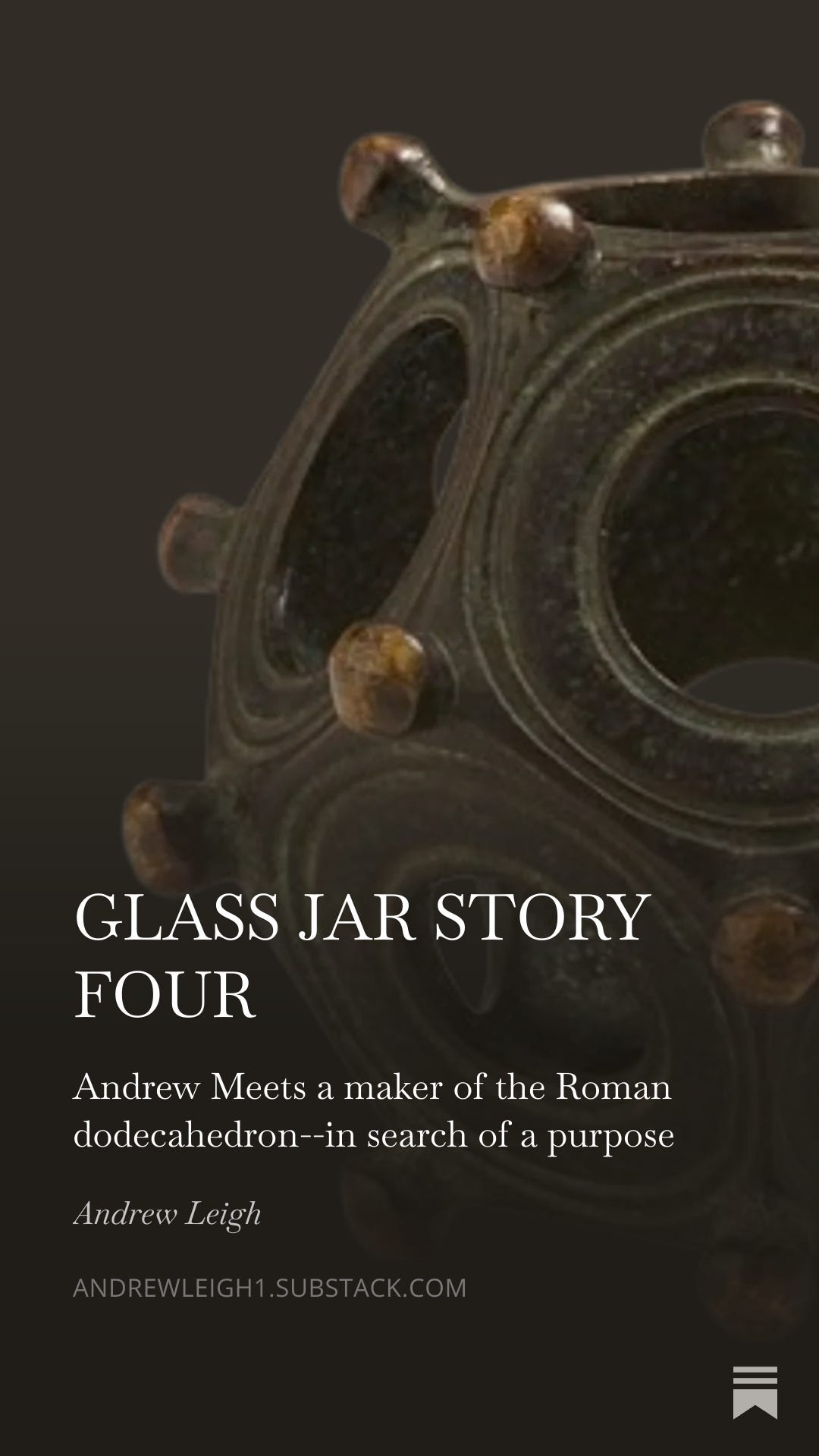
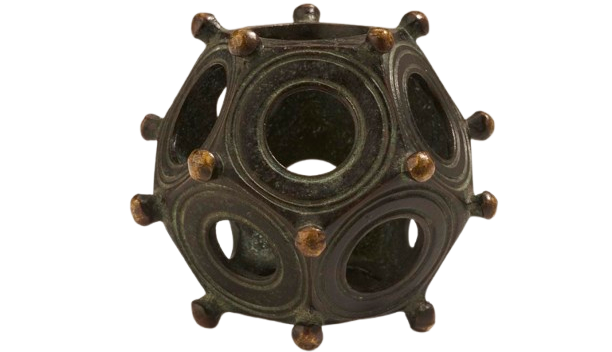
On the bench before him: a dodecahedron. Twelve pentagonal faces, each pierced with a circular hole, no two holes the same size. At every corner, a small knob, precise as a full stop. He sets it down as I enter and looks at me without surprise.
“You want to know what it is?” he says.
A: Yes.
“Everyone does.” He picks up a file, draws it once across an edge. “Sit down.”
I sit.
A: How many have you made?
“Many.”
A: For whom?
“For those who order them.”
A: That is not an answer.
“No,” he agrees pleasantly. “I suppose not.”
He holds the piece up. In the lamplight, the bronze glows with a warmth that seems disproportionate to its size; it is perhaps the span of two fists, no more. He turns it slowly, and the holes catch the light one by one, each a different diameter, each perfectly finished.
A: It is Roman work.
“I am a Roman craftsman.”
A: And yet nothing Roman exists that explains it. No text. No inventory. No official record.
He sets it down again. “Rome records what Rome understands. Rome does not understand everything.”
A: What does it do?
He looks at me with something that might, in a more forthcoming man, have been a smile. “It does what it needs to do.”
A: For whom?
“For the person holding it.”
A: The holes are different sizes. There must be a reason.
“There is.”
A: The knobs at the corners.
“Yes.”
A: The twelve faces.
“Also, yes.” He is not mocking me. He answers each fragment with complete seriousness, confirming without explaining, as a man might acknowledge that a door exists without opening it.
A: “You know exactly what it is for.”
“Of course.”
A: And you won’t tell me. Yet I have travelled far to meet you.
He considers this with what appears to be genuine regret. “I will tell you what I can.”
A: Then tell me that.
He is quiet for a moment, turning the piece in his hands.
“I learned this work from my father,” he says. “He learned it from his. How far back that goes,” he sets the dodecahedron down carefully, “I have stopped trying to count. Further than Rome. Further than the roads.”
A: Further than Rome. And yet you work in bronze. Roman bronze.
“I work in whatever is available. The material is not the point.”
A: What is the point?
“The form,” he says. “The form is very old. The form is the thing.”
A: Why twelve faces?
He looks at me steadily. “Why do you ask questions you already sense the answer to?”
A: Because sensing is not knowing.
At that, something shifts in him, not warmth exactly, but recognition. He picks the object up again.
“I will tell you this. Every one I make is the same and not the same. The form does not change. The holes change. The sizing of the holes is particular. That is made for a particular purpose for a particular person.” He pauses. “I do not choose the sizing. The sizing is told to me.”
A: By whom?
“By those who want them.”
A: The same people you make them for?
“Yes.”
A: And they know what it is for?
He nods. “I learned the trade from my father, and part of that learning is not to ask awkward questions. I receive the orders, I make the object and deliver it, and they pay, without fail. These days, that’s worth quite a bit in these troubled times.”
I look at the object on the bench between us. Found across the whole of northern Europe, Gaul, Germania, Britain, always in the earth, always alone, never explained, never depicted, never mentioned by any Roman writer who recorded everything else down to the price of fish in Ostia.
A: You must be aware that in millennia from now, no one will have the faintest idea what this was for.
He receives this without apparent distress. “Good,” he says.
A: Good. What do you mean by “good?
“Some knowledge is not lost by accident. It is allowed to go.” He runs his thumb once across a knob at the corner of the piece. “Rome wants to name everything. To record everything. To own everything by writing it down. There are those of us who believe that certain things remain useful precisely because they are not written down. Not owned. Not explained.”
A: Even at the cost of being forgotten?
“Forgotten by whom?” He looks up. “By Rome? Rome itself will not last. By the men who need these?” He shakes his head. “They will not forget. They will stop when the need ends. When the need ends, the knowledge ends. That is not a loss. That is completion.”
A: And if the need never ends?
He picks up the dodecahedron one final time and sets it at the edge of the bench, closer to me than to him.
“Then someone will make them again, and they will not know why. They will not know where it comes from. They will find that the form is right, and the form demands to be made, and they will make it.”
A pause. “They will call it instinct. Or art. Or mathematics. They will give it a new name and believe it is new. He picks up his file again. “It will not be new,” he says.
The conversation, I understand, is over. I leave the dodecahedron where it is. Somehow it seems important not to touch it.
I write imagined conversations with history’s most remarkable figures: women, Visionaries, and creative minds. Not summaries, but actual encounters. Real lives, reimagined in dialogue.
If you’ve ever wanted to hear the past answer back, you’re in the right place. I call it History Speaks.