by Andrew Leigh
[Published 28 April]
Conversations with those who
were actually there.
by Andrew Leigh
[Published 28 April]
Conversations with those who
were actually there.
The Marino glass factory floor is loud with heat and breath, and the slow turning of liquid glass on iron rods. Marco, the owner and manager, has been showing me molten miracles for an hour. At the far end of the floor, he stops.
“For security purposes, there is one piece we never display. Would you care to see it?”
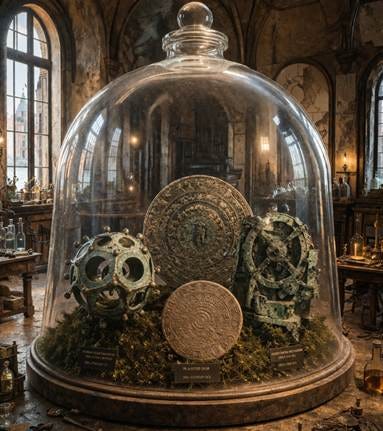
He guides me through two doors into a small, private room. On a plain wooden table sits the jar, large, clear, and old. As I move around it, small bubbles suspended within the glass walls cause a slight distortion that shifts whatever sits inside.
Within it are five objects arranged with a clear purpose. Marco speaks softly, like a man does when he’s in the presence of things he respects but cannot explain. He points without touching:
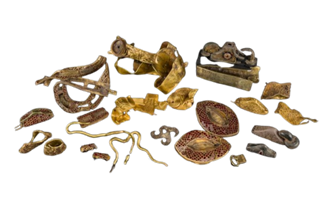
“Do you see? Anglo-Saxon gold. Buried in Mercian soil in the seventh century. Whoever buried it was careful. Their placement was deliberate, not hurried. A warrior? A priest? No one knows. And no one ever came back to claim it. Why not? That is the question that will not go away.”
Marco leaves that to lie before pointing once more:
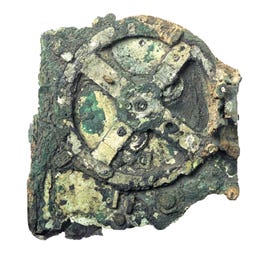
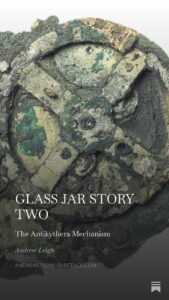
The Antikythera Mechanism
“This one has kept experts guessing for eternity. The device was found in a shipwreck off the Greek island of Antikythera in 1901. It’s a bronze computer in all but name. With gears, dials, and moving parts, it was far more intricate than anything that era should have been able to produce.
It was on a Greek ship when it sank. Who made it? No civilisation of that time should have possessed the knowledge or the tools. Yet, there it was. There it is, in this glass jar.
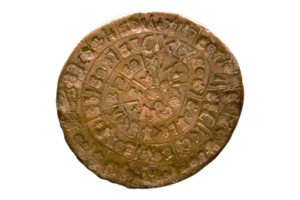
A pause. “And then there’s the clay disc.
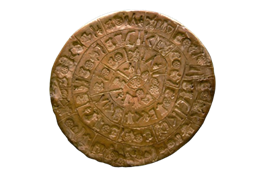
It is pressed with symbols on both sides, in a spiral and then sealed into the floor of a Minoan palace before the fires came. The symbols are unlike any known script. Scholars have been arguing about them for a century. No one has read a single word.”
Someone buried it deliberately under the floor. Whatever it says, it was important enough to preserve and important enough to hide.
Once more, Marco looks at the jar rather than at me. Pointing again:
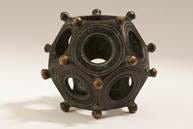
“Now that twelve-sided object is a Dodecahedron, made of bronze. It is hollow, with a hole in each face and found across northern Europe, always in the earth.
Yet this mysterious object is never mentioned in any Roman text. Not one. Soldiers carried them, perhaps. Or priests. No one knows what for. No one has ever explained it.”
Even as I reflect on this curious, inexplicable object and wonder who made it and why, Marco presses his fingertip against the glass, points without touching.
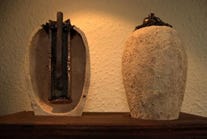
“And finally, that one at the back, out of sight from the front, is what confuses everyone. As it should.
It’s made of clay, barely the size of a fist, sealed at its neck with a dark, resinous plug crafted from bitumen. That is the same substance used by people to waterproof boats on the Tigris four thousand years ago.
A German archaeologist found it in 1936 near Baghdad. In fact, he found several such jars, a fact nobody talks about. When you fill it with vinegar or wine, it produces an electric current of roughly 2 volts. This was demonstrated at a General Electric laboratory in 1940.
It is Parthian, perhaps 250 BC. Serious scholars say it was a storage jar. For scrolls. For sacred objects. But nobody has ever explained the deliberate corrosion on the iron rod, acid corrosion that generates electricity in an era that knew nothing of the existence of such a force.”
He stands back and looks at it through the glass, the way you look at something you’ve studied a thousand times and still can’t resolve.
“Nobody knows what it was for.”
As we leave the Glass Jar room, I reach a decision. I will research one of my imaginary conversations to shed more light on these five unsolvable mysteries.
I thank Marco for the tour and will not forget his final words:
“If you find anything more about these five world-class mysteries, be sure to let us know what you discover.”