The Bagdad Battery
I am in Ctesiphon, Mesopotamia, around 100 CE. By invitation, I have entered a workshop near the royal capital. In the corner, a clay kiln smoulders, and copper shavings litter the floor.
Darius, a Parthian goldsmith to whom I have recently been introduced, is working on something on his bench. He acknowledges my arrival, but does not cease his attention to his task.
A: Darius, what is that strange jar you’re assembling? I’ve never seen anything like it.
He sets down a small clay pot, roughly seven fingers tall, and wipes his hands:
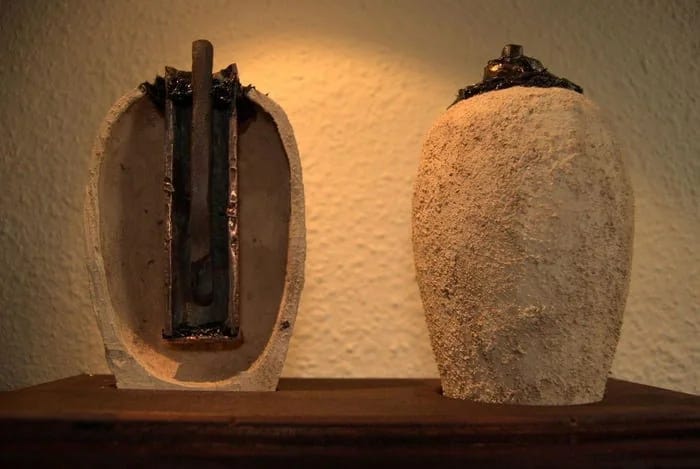
“This? A gift from my father’s father. A simple thing, a pot of fired clay, a rolled sheet of copper hammered into a tube, and an iron rod set inside.
I close it here, do you see, sealed with asphalt/bitumen. You know, the stuff they cover ships with to make them seaworthy.
Wine that has turned sour goes in here, plus grape vinegar from the market. It must be the sharp stuff the traders bring from the western provinces.”
A: What do you do with it?
“You pour the liquids into the copper tube until it is submerged. Then something… happens. I can hardly describe it, let alone explain it. There’s a tingling. An invisible force that moves through anything metal that touches the rod.
I do not recognise that force, I only know what I have seen. Touch the rod and the copper at the same time, and your fingers will buzz. Hold it longer, and your hand cramps.”
A: What exactly is this force?
“We don’t have a specific name for it. We call it the force in the jar. My grandfather mentioned that a healer in Seleucia used something very similar. He would press two thin bronze needles into a man’s flesh and connect them to the jar. He claimed it removed bad spirits from the joints.
That is the secret my family keeps. If you hang a small silver figurine from the iron rod soaked in vinegar overnight, it will, in the morning, have a thin layer of gold—not painted or beaten on, but grown onto the surface like frost on winter reeds.
My patrons at the court of Ctesiphon believe I am a sorcerer, and I allow them to think so.”
A: Remarkable, Darius. Have you tried linking several of them together? Would that make the force stronger?
“Yes. I have tried three in a row, connected with copper strips. The buzzing turns into a sharp shock, painful enough that a man would shout. Ten together? Well, I tried it once. I will not do it again.
I have made perhaps a dozen jars over the years. Some failed because the copper tube was positioned incorrectly, or the rod touched the sides. You can tell immediately, no force at all—those I buried without ceremony. Maybe someone will dig one up one day and be very confused.”
A: Why are there bowls with strange writing buried nearby? I noticed them when I came in.
“We live in the same world of invisible forces. My force-in-the-jar is just one of them”.
A: Did you ever write any of this down? The proportions, the method, and how it works?
“Write it down? And have every coppersmith in Ctesiphon offering golden figurines for half my price by spring? No. My son will learn it the way I learned it, by watching my hands, not reading my words. The secret stays in the family, or it dies with us.
Though I sometimes wonder. If the Arabs ever come, the libraries burn, the empire falls, would anyone even realise this was possible? Would they think we were storing scrolls in strange pots?”
A: One last question. Do you think anyone will ever figure out what you made here?
Darius picks up the jar. Turns it slowly in his hands and sets it down:
“Probably not. Men look at things and see what they expect to see. They’ll find the jar and think, “ Ah, a storage vessel. Or a sacred object. Or a curiosity from confused people who didn’t know better.”
One thing I am certain of is this: they will not believe that a man stood here, in a clay workshop, near the greatest city in the world, and coaxed an invisible force out of sour wine and two pieces of metal because he wanted his statues to shine like the sun.

I write imagined conversations with history’s most remarkable figures: women, Visionaries, and creative minds. Not summaries, but actual encounters. Real lives, reimagined in dialogue.
If you’ve ever wanted to hear the past answer back, you’re in the right place. I call it History Speaks.